By Eamonn Ryan
Looking back across the two days, it is hard to escape the conclusion that the Pan African Data Centre Conference was, at its core, a cooling and energy event.

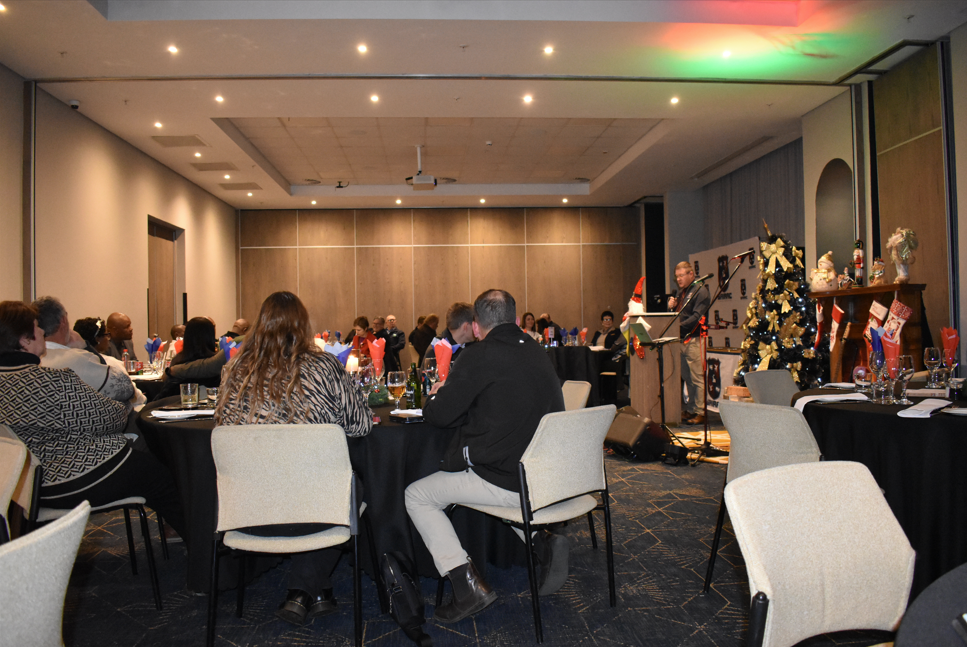
Mark Acton of Acton Consulting (left) and Snehar Shah, CEO
of IX Africa (right) All images by © RACA Journal
The 2026 Pan African Data Centre Conference, held on 23–24 June, reinforced a message familiar to RACA Journal readers: Africa’s digital future will be shaped as much by cooling and energy as by computing. Across the conference, exhibitors showcased solutions for high ambient temperatures, constrained grids and increasingly dense AI workloads, many of which will be explored in future issues.
One of the standout moments of the conference was a panel discussion on the future of African data centres in the age of AI, sovereignty and sustainability. On stage was an East African operator, Snehar Shah, CEO of IX Africa, and Mark Acton of Acton Consulting. Shah’s story neatly captured many of the conference’s recurring themes. “We chose to go big,” he explained, describing a 22.5MW data centre campus built on a five-acre site. The first 4.5MW are already live, instantly making it the largest facility in its market. That decision to scale from the outset was driven as much by cooling and power considerations as by commercial ambition: rising cabinet densities and the arrival of GPU-heavy workloads demanded a site designed from the ground up to handle high floor loading, solid floors instead of raised, and aggressive power densities without sacrificing efficiency.
The discussion quickly turned to GPUs and AI. The operator already supports four clients running GPU-as-a-service and has engineered the site to accommodate up to 50kW per rack while still relying on free-air cooling. The site has been engineered for rack densities of up to 50kW while still relying on free-air cooling. The discussion suggested that, with careful thermal design, air cooling can remain viable at much higher rack densities than is often assumed, delaying the need for liquid cooling.

DATA CENTRES
Behind the technical details lies a broader story of demand.
The panel linked the rapid growth in data centre capacity to Africa’s wider digitisation journey. With a population of around a billion and a young, mobile-first demographic, the continent is embracing digital services at speed. Kenya’s rapid digitisation, together with new submarine cable investments, fibre expansion and low-Earth-orbit satellite connectivity, is driving demand for local data centre capacity.
Kenya’s data protection legislation is also encouraging organisations to keep sensitive workloads within national borders. This is creating demand for local facilities capable of supporting hyperscale platforms while meeting sovereignty requirements.
Kenya already generates about 93% of its electricity from renewable sources, primarily geothermal, hydro and wind. Recent regulatory changes allowing private power purchase agreements strengthen its appeal as a data centre location.
Speakers cautioned that renewable energy alone does not determine site selection. Successful facilities must also balance access to fibre, skilled labour and customers.
The operator has already brought the first Oracle hyperscale region to East Africa, supporting government and banking workloads. Panellists expect further hyperscaler investment as AI inference, industry-specific models and private AI deployments continue driving demand for regional capacity.
Running through all of this is the question of talent. They highlighted the importance of developing local engineering talent. IX Africa recruits mechanical and electrical engineers, retrains them for data centre operations and, through partnerships with organisations such as Nomad Futurist, equips them with skills that are increasingly sought after internationally.
Almost every strategic question – how to host AI; how to satisfy sovereignty requirements; how to attract hyperscalers; how to build in secondary markets – ultimately came down to how best to deliver reliable, efficient power and remove vast quantities of heat in some of the most challenging and interesting environments in the world.
The conference reinforced that cooling and energy have become central to Africa’s digital future. In future issues, RACA Journal will examine many of the technologies showcased – from free-air cooling and high-density rack design to renewablepowered data centres and advanced thermal management – in greater technical detail.