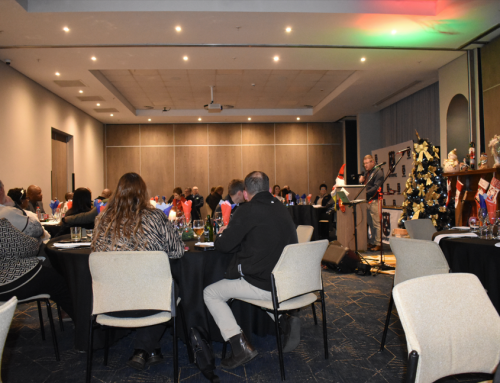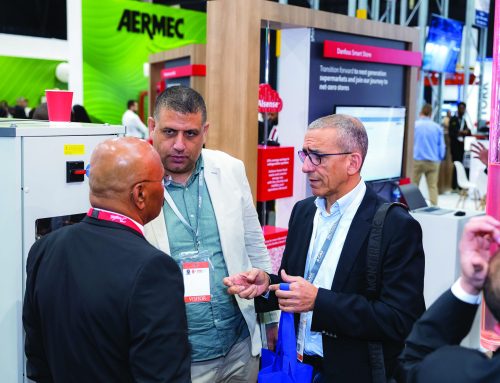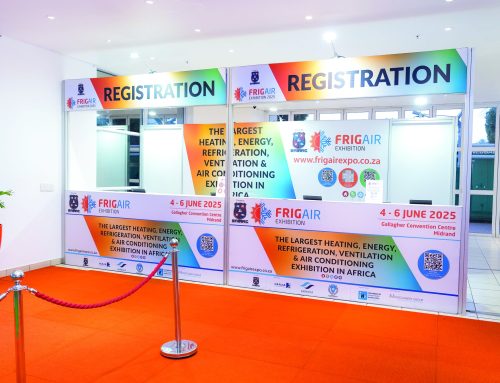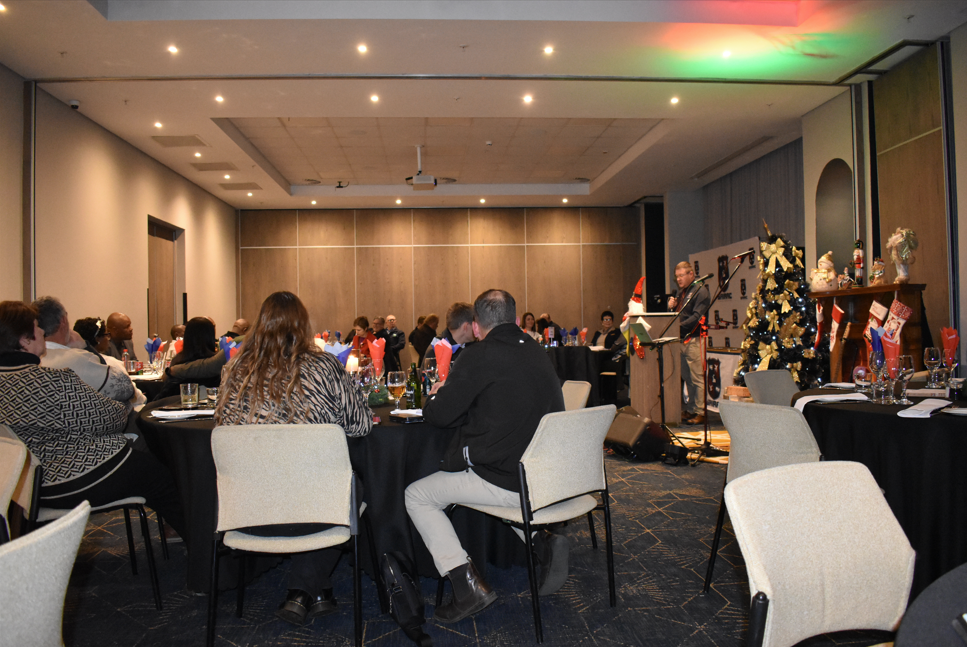
A packed panel discussion at Solar & Storage Live Africa 2026, where industry leaders unpacked the future of renewable energy, storage systems and grid resilience in Africa’s rapidly evolving energy landscape. © RACA Journal
The Solar & Storage Live Africa held in Gauteng March – and later in the year in Cape Town – has firmly established itself as one of the most important gatherings for the energy sector on the African continent. Rather than functioning as a conventional trade exhibition alone, the event has evolved into a dense, fast-moving intersection between technology showcase, policy dialogue and real-world project financing conversations – all centred on the accelerating transformation of Africa’s energy landscape.
Many of the panel discussions were of a high, intellectually stimulating calibre that were typically packed and provoked many questions.
While the exhibition floor draws significant attention with its scale and diversity of solar, storage, inverter and smart energy technologies, it is the conference programme that increasingly defines the strategic value of the event. While the supplier stands were primarily international, and especially dominated by Chinese suppliers, the panels were largely South African. Across multiple stages and sessions, industry leaders, policymakers, developers, financiers and technical specialists unpacked the realities of deploying renewable energy at scale in a context shaped by grid constraints, rapidly rising demand and ongoing energy insecurity. Topics ranged from utility-scale procurement and wheeling frameworks to behind-the-meter commercial and industrial solutions, as well as the growing role of battery storage in stabilising renewable-heavy systems. What emerged consistently across discussions was a recognition that energy transition in Africa is no longer theoretical – it is being driven by necessity, economics and system “resilience” (a word that featured in almost every sentence).
A particularly notable dimension of the 2026 event was the strong emphasis on practical implementation rather than conceptual optimism. Case studies and project-level insights highlighted how hybrid energy systems, microgrids and distributed generation are already reshaping how businesses and municipalities approach energy supply. Storage, in particular, featured prominently as the enabling layer that is allowing solar PV to move from an intermittent supplement to a more dispatchable and dependable resource.
Against this backdrop, the presence of RACA Journal throughout the conference and exhibition added an important layer of industry documentation and interpretation, capturing insights that extend
beyond the immediacy of the conference itself. These interactions are already feeding into editorial coverage, with several articles having been published online and on social media, and further in-depth features scheduled for upcoming issues. In this way, RACA
Journal is not only reporting on the sector’s evolution and how it affects the HVAC&R sector but actively contributing to the ongoing knowledge ecosystem that events like Solar & Storage Live Africa help to shape.
Ultimately, the 2026 conference reinforced the sense that Africa’s energy transition is being built in real time through collaboration between technology providers, engineers, financiers and policymakers. The event served as both a mirror of current challenges and a map of emerging solutions, with the conference helping to translate complex industry shifts into accessible, actionable understanding for the broader built environment and HVAC&R sectors.
© RACA Journal