By Eamonn Ryan
South Africa’s construction and engineering sectors are showing renewed confidence, and the signal is coming through loudest from renewable energy development.
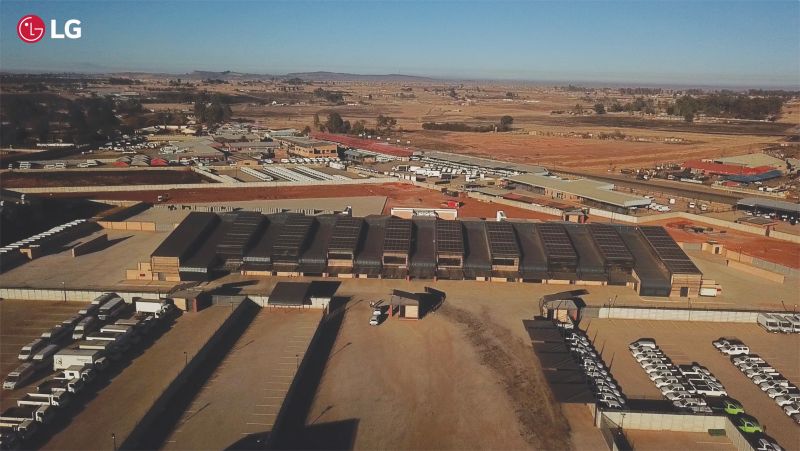
I and S Workshops and Warehouse, located in De Deur, enjoys energy efficiency – all while operating entirely off grid. All images supplied by LG Electronics South Africa
Recent industry surveys indicate that activity linked to clean energy generation is now one of the strongest drivers of growth in civil construction, pushing confidence to its highest level in more than a decade. While broader infrastructure investment remains uneven, renewables have emerged as a bright spot – catalysing work, improving profitability and restoring momentum across the value chain.
The latest FNB/BER civil confidence index jumped nine points to 52, the best reading since 2016 and the joint highest in 11 years, indicating that more than half of respondents were satisfied with prevailing business conditions.
This resurgence is not only about megawatts added to the grid. It reflects a deeper shift in how energy is generated, managed and consumed – with implications that extend well beyond power plants into the buildings we design, operate and condition every day. As renewable generation expands, the focus is increasingly turning to demand-side efficiency: reducing energy loads, optimising HVAC&R systems, and ensuring that buildings are designed to work with available energy rather than against it.
For the HVAC&R sector, this alignment between renewable energy and energy efficiency is critical. Renewable power performs best when paired with buildings that are inherently low-energy, well insulated and intelligently controlled. In this environment, zero energy buildings, hybrid HVAC systems and on-site solar solutions are no longer aspirational concepts – they are practical responses to economic pressure, grid instability and sustainability targets.
This feature explores how that convergence is taking shape – from nature-inspired zero energy buildings to modern HVAC&R strategies and solar solutions that are redefining sustainability across Africa’s built environment.
Lessons from LG’s De Deur off-grid HVAC project
The I and S Workshops and Warehouse, De Deur, project emerged from a fundamental design challenge: delivering a fully functional, high-performance HVAC solution for a commercial building designed to operate on 100% solar power. Situated in a remote location with no access to Eskom infrastructure, the development was forced to confront its energy strategy from the earliest planning stages.
“With no municipal supply available, the question wasn’t how much backup we needed – it was whether we needed the grid at all,” explains Andries Bekker, ECO Solutions general manager at LG Electronics South Africa.
From an infrastructure perspective, the client faced a choice: invest an amount in a new electrical substation, or pursue a standalone solar solution. Rising electricity costs and ongoing grid instability tipped the balance decisively. A solar installation ultimately replaced the need for the substation entirely, immediately reshaping how the rest of the building systems were designed.
“That decision changed everything. Once the client committed to going fully solar, every other system, especially HVAC, had to justify its energy demand,” Bekker says.
The facility now operates entirely on solar power, with no reliance on municipal electricity and only a diesel generator retained as a contingency measure. Achieving this level of energy independence for a building of this scale required a tightly integrated design approach, particularly for HVAC, identified early on as the dominant electrical load.
“We knew from day one that air conditioning would be the biggest consumer of energy in the building. So the HVAC system couldn’t just be efficient – it had to be intelligent and responsive to the available power,” Bekker notes.
From the outset, the air-conditioning system was required to deliver more than occupant comfort. It had to integrate seamlessly with the solar plant, modulate its capacity in response to real-time energy availability/sunlight, and maintain high efficiency across varying operating conditions. Energy performance, capacity control, lifecycle cost and remote monitoring capability all became central design criteria.
MBS Engineers, appointed as the client’s mechanical consulting engineers, were responsible for the HVAC design and for overseeing construction and cost management. With energy efficiency embedded as a core design philosophy, the team selected an LG MultiV5 variable refrigerant flow (VRF) system for the project.
The Multi V5 platform has demonstrated consistent efficiency improvements of 40–50% compared to conventional constant-speed compressor systems. Beyond reduced energy consumption, the system offers heat recovery capability, simultaneous heating and cooling, individual zone control and reduced installation and space requirements – attributes well suited to an energy-constrained, off-grid environment.
The De Deur project reflects a broader shift in thinking around renewables. Rather than simply adding solar panels to a conventional building design, the project demonstrates how efficiency-led system selection determines whether renewable energy solutions are viable in the first place.
“There’s a misconception that you can solve energy problems by just throwing solar at them. Our view is the opposite – efficiency must come before renewables. If your loads aren’t optimised, no amount of solar will save you,” says Bekker.
That principle was put to the test at De Deur. Engineers worked closely with an energy-literate client who owns multiple properties and understood the long-term implications of energy decisions. Selecting inverter-driven VRF technology was not optional; it was fundamental to making a fully off-grid building possible.
That early efficiency-first mindset ultimately determined whether going off-grid was feasible at all.
Which buildings can go off-grid?
From LG’s perspective, not all building types are equally suited to off-grid or solar-dominant HVAC solutions. Load profile remains the defining factor.
Standard office buildings operating on an 8–5 daily schedule are among the most suitable candidates. In these environments, HVAC demand aligns closely with peak solar generation, allowing systems to operate directly from solar power during the day with minimal reliance on batteries. “At De Deur, the office building can run entirely on solar during daylight hours. The batteries are there, but they’re not carrying the full load,” Bekker explains.
Warehouses, however, present a more complex challenge. Many operate on a 24-hour cycle, shifting a significant portion of energy demand into night-time operation. While solar-assisted HVAC is still possible, it becomes a hybrid scenario where battery capacity – and cost – becomes critical. “You can do it, but the economics change. Fully off-grid warehouses are still the exception rather than the rule,” Bekker says.
What sets the De Deur installation apart is its adaptive capacity control, which dynamically links HVAC output to available solar and battery power – an industry first in South Africa.
In practical terms, the system receives real-time feedback from the solar inverter via analogue signals. The inverter communicates the current charging capacity of the solar array, and the VRF system responds by adjusting its own output accordingly.
“If solar availability drops because of cloud cover, the air conditioning doesn’t suddenly pull hard from the batteries. Instead, it steps down smoothly.”
For example, a reduction from 100% to 90% solar availability might result in HVAC capacity being reduced to around 80%.
Further reductions follow a stepped logic designed to maintain comfort while protecting the energy system. Only when solar availability drops below a defined threshold does the system shut down completely – a scenario that has never occurred at De Deur due to correct system sizing.
“That’s the real value of intelligence.You prioritise resilience and continuity instead of brute-force performance,” says Bekker.
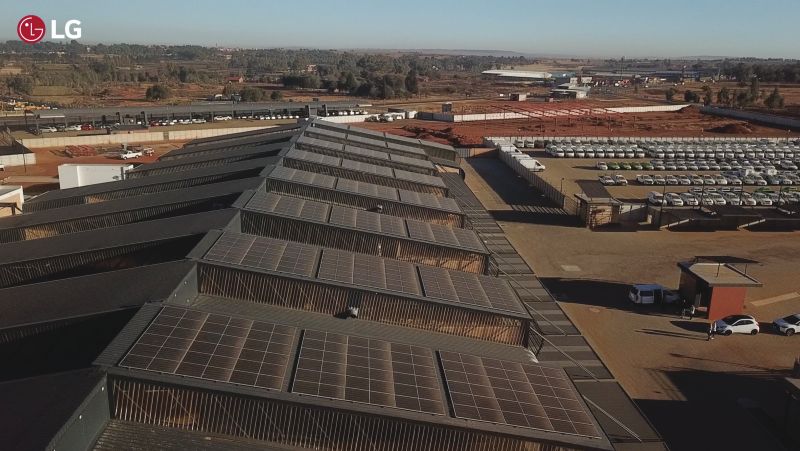
I and S Workshops and Warehouse, located in De Deur, is a good example of a sustainable building practices.
Managing technical risks off-grid
Operating off-grid introduces risks beyond HVAC equipment itself. One of the most significant challenges identified early on was power transition stability, particularly when integrating solar, batteries and generator backup.
In conventional buildings, rapid changeovers between generator and utility power – often occurring in less than a second – can cause severe voltage dips and inrush currents exceeding 500 amps, leading to premature equipment failure.
At De Deur, this risk was mitigated through carefully designed interlocks and a third-party time-delay system. When transitioning between generator and solar power, a 30-second delay is enforced before power is reapplied.
“That delay allows voltages to stabilise and prevents damaging inrush currents. It’s a small detail, but it makes a massive difference to long-term reliability.”
For developers and building owners, balancing higher upfront investment against long-term operational savings remains a challenge. Bekker notes that while regulatory pressure is increasing – particularly for public-sector buildings – many private developments still focus on short-term cost reductions. “Too often, energy strategies stop at lighting upgrades,” he says. “LEDs help, but HVAC is where the real energy is being used.”
Investing in inverter-driven, renewable-ready HVAC systems delivers compounding benefits: reduced peak demand, improved compatibility with solar and batteries, and greater operational resilience during grid instability.
“In South Africa, resilience has a value that goes far beyond kilowatt-hours.”
A proven, but underutilised model
LG sees systems like Multi V5 as central to future hybrid PV, battery and grid-interactive strategies. The De Deur project has already been used as a regional case study in markets facing similar grid challenges.
Despite its technical success, however, Bekker remains realistic about adoption. Interest in solar-assisted HVAC surged during periods of severe load shedding but has softened as grid conditions stabilised. “The model works. The challenge now isn’t technology – it’s mindset and investment priorities,” he says.
For engineers and developers under pressure to deliver immediate energy reductions rather than aspirational net-zero targets, Bekker’s advice is pragmatic. “The first step is simple. Move away from constant-speed, on/off compressors to inverter technology. That alone delivers immediate gains.”
While some markets have shifted back toward chilled water systems, VRF remains better suited to solar integration due to its modularity and capacity control. “Large chillers need massive solar and battery systems. With VRF, you can prioritise critical zones and manage energy far more intelligently.”
The De Deur project demonstrates that off-grid, solar- dominant HVAC is not theoretical. With efficiency-led design, intelligent controls and integrated planning, it is already achievable today under South African conditions.
“And that,” Bekker emphasises, “is where the real energy conversation needs to start.