Compiled by Eamonn Ryan
The Variable Refrigerant Flow (VRF) market is surging, powered by energy- efficient technology, advanced refrigerants and intelligent climate control solutions. From flexible multi-zone comfort to sustainable, low-GWP systems, VRF innovations are transforming commercial and residential HVAC.

MS Aircon custom air handling unit (Petra) in its showroom. Supplied by Petra
Global VRF systems market poised for robust growth
The global VRF systems market is experiencing significant expansion, with projections indicating a rise from approximately R250-billion in 2024 to around R430-billion by 2030, reflecting a compound annual growth rate (CAGR) of 9.6%. This is according to: Markets-and-Markets 2025.
This growth trajectory is propelled by several key factors. Firstly, the increasing demand for energy- efficient heating, ventilation and air conditioning (HVAC) solutions is a primary driver. VRF systems, known for their ability to provide precise temperature control and energy savings, are becoming the preferred choice in both residential and commercial applications. For more information on this, see the profiled project in this issue.
Technological advancements further bolster the adoption of VRF systems. The integration of inverter-driven compressors allows for variable speed operation, enhancing energy efficiency and reducing operational costs. Additionally, the use of eco- friendly refrigerants such as R32 aligns with global environmental standards and regulations, making VRF systems a sustainable option in modern HVAC design.

The versatility of VRF systems also contributes to their growing popularity. Their ability to simultaneously heat and cool different zones within a building offers flexibility and comfort, catering to the diverse needs of occupants. This capability is particularly beneficial in buildings with varying thermal loads, such as multi-story commercial complexes and large residential developments.
In conclusion, the Markets-and-Markets 2025 research finds that the VRF systems market is set for substantial growth, driven by the increasing emphasis on energy efficiency, technological innovation and versatile HVAC solutions. As these systems continue to evolve, they are expected to play a pivotal role in shaping the future of sustainable building infrastructure.
Midea and the global VRF market: Innovation, sustainability and training Midea, in particular, has been strengthening its global footprint and technical capabilities through extensive R&D investment, a broadened product portfolio, and a far-reaching training and support ecosystem. According to Neil Moriarty, CAC director at
Livance: “Improved user comfort requirements, improved energy efficiency requirement, intelligent solution upgrades and growth in emerging markets are continuously driving the development of the VRF market. Midea’s VRF systems consistently adhere to a technology-led and localised operational strategy, continuously providing high-efficiency, energy-saving, green and comfortable HVAC solutions for the building sector.
Midea Building Technologies (MBT) Academy operates 54 training centres across 37 countries spanning six continents (Asia, Europe, Americas, Africa, Australia), including self-owned flagship facilities in China, Italy and US, alongside collaborative centres established with over 32 international partners. This network delivers technical training for HVAC and appliance industries, featuring regional service centres in critical markets across Europe (17 countries), MEA (11 countries), APAC (six countries) and the Americas (nine countries).”
As part of its drive to strengthen global expertise and accelerate the shift toward low-carbon HVAC technologies, Midea continues to refine the core engineering behind its VRF portfolio – particularly in inverter-driven compressor performance and the transition to next-generation refrigerants. This focus on technical innovation is supported by an expanding international training ecosystem designed to upskill partners, engineers and technicians across multiple regions.
“Midea’s self-design compressors adopt full DC inverter technology, enhancing compressor efficiency and stability through high-precision algorithms and patented oil balancing systems.
“In addition to the online MBT headquarter training, we also offer our clients an online training platform called MBT Academy. Clients can learn about all MBT products anytime, anywhere on their mobile phones or computers. The courses cover all of our products, including VRF, chiller, heat pump and package units.
The 2025 MBT headquarter training comprises 18 sessions across 12 months, focusing on three key areas: VRF systems (56%, covering V8 Pro/Master/VC Max), R290 heat pumps (28%, Nature/Mars/Arctic HT), and large-tonnage chillers (16%).
Most training (61%) is online, while on-site sessions (39%) are hosted at Shunde (five sessions) and Chongqing HQ (two sessions) with more than 2 000 participants. Besides, we also held four regional VRF training sessions in the MEA region and the Asia Pacific region with more than 100 participants. The programme emphasises technical expertise for HVAC solutions, prioritising eco-friendly R290 technologies and advanced VRF systems.
Beyond product innovation, Midea places strong emphasis on ensuring that VRF systems perform reliably in the field – an area where installation precision, site conditions and environmental factors often create challenges for contractors and engineers. To address these realities, the company has developed a range of technologies and design features aimed at improving installation flexibility, safeguarding system components and enhancing overall performance.
As global refrigerant regulations shift toward lower-GWP alternatives, manufacturers are increasingly required to meet stringent safety standards, particularly when working with mildly flammable A2L refrigerants. Midea has focused on aligning its VRF product development with these evolving requirements, incorporating enhanced safety functions and control strategies to ensure secure operation in all applications.
“Product design strictly adheres to international standards such as EN60335-2-40, addressing the characteristics of A2L refrigerants with the integration of intelligent leakage detection and refrigerant leakage shutdown technologies, ensuring the safe use of A2L refrigerants.”
As buildings become more digitally interconnected, seamless integration between HVAC equipment and modern building management systems (BMS) has become essential for achieving optimal performance, monitoring and control. Recognising the challenges that arise from compatibility differences, installation complexity and varying functional requirements, Midea has prioritised the development of VRF platforms that communicate easily across multiple protocols while offering enhanced cloud- based management capabilities.
“BMS systems typically face several issues: 1. device compatibility, 2. functional scalability, 3. installation complexity. Midea’s VRF systems support various industry-standard communication protocols such as BACnet, Modbus and KNX, ensuring seamless integration with BMS from different manufacturers. We are not only providing a gateway to support the protocol but also integrating the protocol into our central controller. Meanwhile, Midea supports cloud control and monitoring, providing customers with our own iBuilding platform, enhancing the system’s flexibility and manageability through data synchronisation and remote control.
Stable operation, high efficiency, energy saving, environmental protection and smart control are the eternal goals of air-conditioning systems. “Midea has established 38 R&D centres globally, including 16 domestic R&D centres and 22 overseas. By integrating local resources, Midea achieves localised development and establishes a global R&D scale advantage.
Midea implements the ‘user-centered’ ‘Three Generations’ R&D model, ‘develop one generation, reserve one generation, study one generation’, to ensure the company has innovative products and technology reserves in the short, medium and long term, to ensure continuous, high-quality satisfaction of user needs. Through a vertical three-level physical R&D organisation, horizontal three-level technology committee and digital operation platform, the high-quality implementation of the three generations is ensured.”
Besides, the newly launched Shanghai Midea Global Innovation Park will take on the global R&D and innovation mission of Midea, gathering thousands of high-end talents and becoming a powerful engine for the deep integration of technology and industry.
Toshiba R&D drives the next generation of smart, safe and sustainable VRF Technology
Toshiba’s latest R&D efforts highlight a comprehensive push toward smarter controls, safer refrigerants and more reliable VRF performance. The following overview explores innovations pointing to a future where VRF systems deliver higher efficiency, improved safety, reduced downtime and a far more streamlined user and technician experience.
Naas Massyn, national sales manager Toshiba, says: “Toshiba R&D is focusing on smarter, advanced inverter compressor control and refined EEV algorithms for precise refrigerant and oil management. Moreover, model-predictive and AI controls that sequence compressors, outdoor units and heat-recovery branches to maximise part-load efficiency in cooling, heating and mixed mode operation. Furthermore, Integration with BMS for demand-response, predictive maintenance and migration to lower-GWP refrigerants for sustainability.”
He adds that Toshiba has already addressed the low-GWP transition with the SHRM-Advance VRF, an innovative VRF operating on R32 and can work as a heat pump or heat recovery system. “Regulation challenges are being addressed, including refrigerant charge limits, mandatory leak-detection and ventilation requirements to meet A2L safety classifications.
“Toshiba R&D is focused on optimised refrigerant distribution, enhanced leak-detection algorithms and regulatory compliance with emerging safety standards while maintaining top VRF performance.
“Sensor and IoT technologies are reshaping VRF development by enabling fast data collection for predictive diagnostics, remote commissioning and AI-driven adaptive control algorithms that continuously optimise system operation. Cloud connectivity supports real-time performance tracking and preventive maintenance.
Toshiba is also a pioneer in introducing NFC communication between the outdoor unit and the technician, allowing instant setup, commissioning and diagnostics via a smartphone, significantly reducing on-site time and service costs,” says Massyn.
He notes that common maintenance issues in multi-zone VRF installations include incorrect refrigerant charging, poor piping practices, misconfigured controls, all of which can lead to reduced capacity or system instability. “Toshiba address this with best-in-class VRF design and selection software that minimises installation errors, plus a structured ‘train-the-trainer’ approach, ensuring local partners, distributors and contractors gain deep technical capability that cascades effectively across their service team.”
The shift to A2L refrigerants has strengthened standard maintenance protocols by adding stricter leak-prevention practices, airflow verification, room size checks and more careful recovery/charging procedures due to mild flammability. Massyn explains that technicians are now expected to follow enhanced safety routines such as using A2L-rated leak detectors, verifying charge limits per room size. “Additional skills include A2L-specific brazing and evacuation practices, familiarity with revised F-gas/ ISO standards and competency in handling systems equipped with integrated leak-detection and safety-shutoff features.”
Modern VRF systems increasingly support automated maintenance features such as embedded fault-detection diagnostics, real-time sensor analytics, refrigerant-leak monitoring and predictive service-intervals through cloud. “These functions allow the system to identify abnormal pressures, temperatures or compressor behaviour early and notify technicians before performance is impacted. By preventing major failures, optimising running conditions and reducing downtime, system longevity is improved and user trust is strengthened.
Customers see quieter operation, fewer unexpected breakdowns and faster/more accurate service interventions,” advises Massyn.
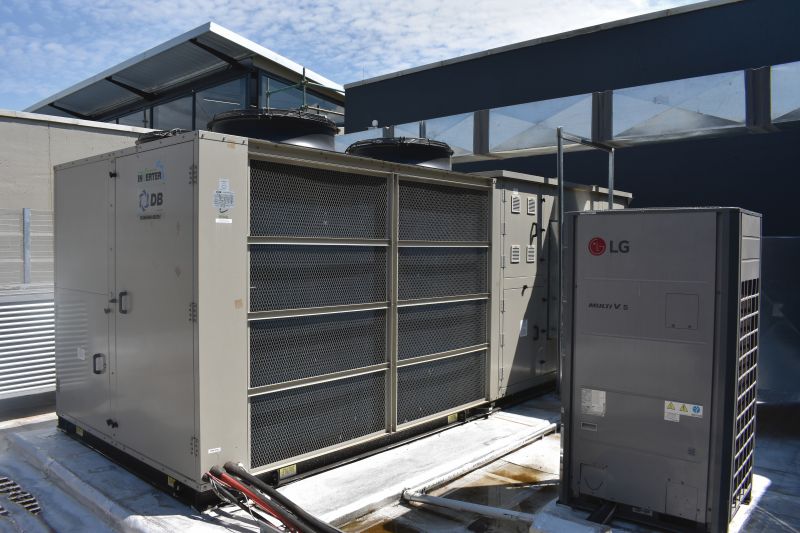
LG Multi V5 at Dhlamini Junction Mall. © RACA Journal
The future of flexible, efficient and safe HVAC
Recent discussions on ASHRAE Journal podcasts numbers 29 and 52 highlighted how VRF technology has advanced over the years, responding to changing refrigerants, international trends and evolving safety standards. The conversations offered a rare inside look at the challenges and opportunities that shape this sector, from simultaneous heating and cooling to the meticulous work behind ASHRAE Standard 15.
At the heart of VRF’s appeal is its flexibility. Unlike traditional HVAC systems, which often require separate units for heating and cooling in each zone, VRF systems use a single refrigerant circuit to serve multiple zones, adjusting output based on demand.
One of the technology’s standout features is its heat recovery capability, which allows simultaneous cooling in one area and heating in another. Scott McGinnis, P.E., a veteran engineer and ASHRAE committee participant, emphasised that this feature is particularly valuable for buildings with varied occupancy patterns or fluctuating thermal loads. “You can transfer energy from spaces that need cooling to spaces that need heating, improving efficiency and lowering operating costs,” he noted.
Despite being commercially available for decades, VRF systems have historically been accompanied by a range of terminology that can confuse newcomers. Different manufacturers have referred to the central component that manages heat recovery – the ‘heat recovery control unit’ – under brand-specific names like mode selector box, flow selector, changeover box or switch box. ASHRAE has worked to standardise this terminology in the VRF guideline SGPC 41 and the Handbook, providing a common reference point for engineers, contractors and building owners. Standardised terminology, the presenters agreed, is crucial for ensuring consistent understanding and safe application across projects.
The evolution of VRF is inseparable from changes in refrigerant technology. In North America, the industry has transitioned from high-global warming potential (GWP) substances like R410A to mildly flammable, low-GWP A2L refrigerants such as R32. These refrigerants represent a significant step forward in environmental responsibility, but their introduction required extensive updates to safety standards. Panellist Christopher William, an ASHRAE Standard 15 contributor, explained that while A2L refrigerants are flammable, they are characterised by low burning velocity and slow flame spread, making them far safer than many initially thought.
Laboratory research even demonstrated that, under controlled ignition conditions, these refrigerants absorb heat and resist rapid combustion – in one experiment, a refrigerant flow repeatedly extinguished candles on a test bench before ignition could occur.
The safety of these refrigerants is codified in ASHRAE Standard 15, the century-old guideline for refrigerant handling and system design in buildings. Originally focused on more conventional systems, the standard has undergone major revisions to accommodate VRF technology and A2L refrigerants.
Over a two-year period, Standard 15 expanded from 18 pages to more than 80, detailing requirements for leak management, fire safety and system operation. The work has been painstaking and collaborative, involving consensus-driven discussions across committees, subcommittees and public review processes. Each proposed change undergoes rigorous debate, review and testing to ensure applicability, defendability and safety in real-world scenarios. It all takes time.
One practical outcome of these updates is the integration of advanced leak detection and safety mechanisms in VRF systems. Modern fan coil units now feature refrigerant leak detectors and upstream shutoff valves. In the event of a leak, these devices can isolate small amounts of refrigerant, preventing large-scale losses and facilitating faster maintenance. Historically, engineers had to design systems assuming worst-case leaks of up to 60kg of refrigerant in a single space, primarily to prevent oxygen deprivation. With these new safety features, leaks are more easily managed and limited, enhancing system reliability and operator confidence.
Looking ahead, the VRF landscape is expected to remain stable and reliable, with incremental improvements in refrigerant technology and safety standards continuing to enhance performance. While Europe experiments with CO₂ and propane systems, North America is likely to remain committed to A2L refrigerants such as R32 for the foreseeable future. This provides manufacturers, engineers and building owners with a predictable foundation for design and operation.
Meanwhile, the integration of advanced monitoring, leak detection and safety shutoffs ensures that VRF systems are easier to manage, more reliable and safer for occupants than ever before.
VRF and VRV systems represent a mature, adaptable and forward-looking solution for modern HVAC needs. From simultaneous heating and cooling to advanced safety measures and globally informed standards, the technology offers a unique combination of flexibility, efficiency and reliability.
Design, installation and maintenance: insights from ASHRAE Journal podcast 29
While VRF systems offer flexibility and efficiency, real-world performance depends heavily on proper design, installation and maintenance. In Episode 29, Kelly Cramm, P.E., Life Member ASHRAE and mechanical engineer with Henderson Engineers, highlighted recurring issues such as premature compressor failures and system underperformance. Her decades of HVAC experience underscore that VRF’s benefits are only fully realised when engineered and maintained correctly.
Common pitfalls
Cramm identified improper installation and insufficient maintenance as the leading causes of system failures. In multi- zone buildings, indoor fan coil unit filters must be changed regularly, yet maintenance staff are often stretched thin. Outdoor condenser coils, typically microfin designs, require at least biannual cleaning to prevent airflow restrictions and system overheating. Unlike traditional DX systems, VRF heat pumps operate year-round, increasing exposure to contaminants and operational wear.
Installation best practices are equally critical:
- Purge refrigerant piping with inert gas (nitrogen or argon) during brazing to prevent slag formation and ensure clean joints
- Require factory-trained, certified installers, as even experienced pipefitters can introduce debris that damages compressors
- Recalculate refrigerant charge if field modifications alter piping length or layout. Overcharging is a common cause of premature compressor failure
- Install suction line side-stream filters with isolation valves to capture residual debris from brazing; these can be valved off after startup
- Ensure compliance with ASHRAE Standard 15 and the International Mechanical Code, particularly regarding refrigerant piping in egress paths
During the design phase, engineers must decouple ventilation from VRF units. VRF fan coils are generally ill-suited to handle latent loads, particularly in humid climates. Using a Dedicated Outdoor Air System (DOAS) ensures proper dehumidification and allows VRF units to operate as sensible-only devices, simplifying operation and eliminating condensate issues.
Contractors also play a crucial role, ensuring that qualified personnel handle critical installation tasks. Integration into building management systems (BMS) remains a challenge due to proprietary controls, though interoperability is gradually improving. Additionally, in cold climates heating capacity declines as outdoor temperatures drop, necessitating backup heat and consideration of wind effects on outdoor units.
Cramm concluded: “VRF systems can deliver outstanding performance, but only when designed, installed and maintained properly. With the right practices, they can be among the most flexible and efficient HVAC options available today.”
References:
- ASHRAE Journal podcast no.29
- ASHRAE Journal podcast no.52
Dhlamini Junction Mall chooses VRF for flexible, efficient HVAC
The recently completed 17 000m² Dhlamini Junction mall in Soweto (see RACA Journal July 2025 issue for full project coverage) highlights the advantages of modern, adaptable VRF solutions. Central to the mall’s heating and cooling strategy was a VRF system from LG, selected for its energy efficiency, flexibility and ease of operation.
Given the mall’s dynamic retail environment – where only half of the units had tenants secured at the start – flexibility was a key design requirement. The VRF system allowed each store to operate independently with dedicated condensing units and ducted hideaway indoor units of standardised sizes, enabling rapid adjustments to shop layouts and tenant-specific requirements. This adaptability simplified installation, reduced co-ordination complexity and ensured consistent HVAC performance across the development.
The VRF system also delivered significant energy savings. Its variable-speed compressors ramp capacity gradually, matching demand rather than operating at full power continuously. This load-matching reduces energy consumption, extends equipment lifespan and supports compliance with SANS 10400-XA energy efficiency standards. Integration with LG’s AC Smart BMS provides real-time monitoring, remote control and an automated generator mode that limits condenser operation during power outages, further optimising energy use.
Overall, the VRF solution offered a scalable, cost-effective, and energy-efficient HVAC approach. It met the operational needs of diverse retail tenants, facilitated rapid changes during construction, and contributed to long-term sustainability goals for the mall.