By Eamonn Ryan
This is the second of a series of two instalments of insights from a SAIRAC Cape Town Centre technical talk.
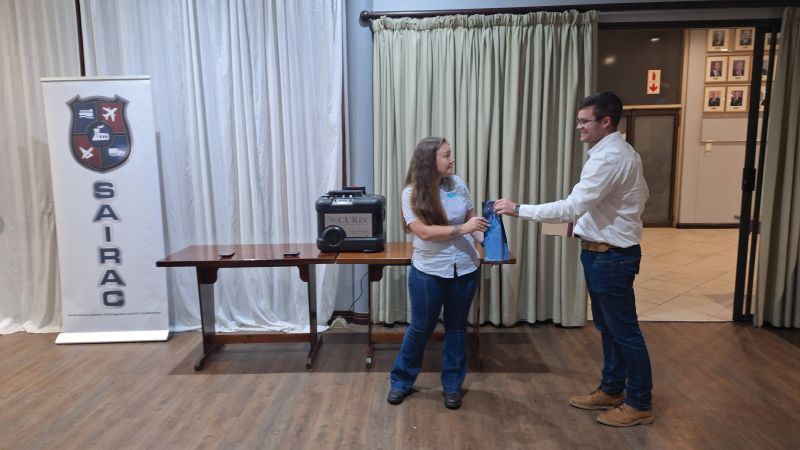
Cassandra-Anne Baxter (ALPA sales general manager), being acknowledged by SAIRAC Cape Town Centre. Supplied by SAIRAC Cape Town Centre
…continued from part one in January.
The Cape Town Centre of SAIRAC recently hosted a technical session on the critical subject of controlling airborne pathogens. The technical talk was a joint presentation by Thabo Mngadi (AFMS mechanical engineer) and Cassandra-Anne Baxter (ALPA sales general manager).
In a standard configuration, the main exhaust duct includes bubble-type dampers, exhaust fans, a BIBO housing, and finally a stack that disperses clean air into the atmosphere. Exhaust velocity must be maintained between 15–20m/s, with stacks extending at least 3m above the highest roofline to prevent re- entrainment of air.
Redundancy is built into the system by specifying two exhaust fans, ensuring uninterrupted operation if one fails. Before filter changes, both fans are shut down and the lab itself placed into shutdown mode.
Decontamination procedures
Between the dampers and the BIBO sits a decontamination box, allowing fumigation of the housing before filters are changed.
Chemical agents such as vapourised hydrogen peroxide (VHP) or formaldehyde are circulated through the housing in a closed loop for up to two hours, neutralising any biological hazards before maintenance begins.
Alternative solutions include trolley-mounted decontamination units, which achieve the same result but with greater mobility. As Mngadi described, hoses and three-inch camlock fittings connect directly to the decon ports, creating a sealed loop that allows fumigant circulation without risk of escape.
Baxter expanded on the protocols, noting that international standards such as the BMBL (Biosafety in Microbiological and Biomedical Laboratories) require a secondary HEPA stage in BSL- 3 and BSL-4 labs. She outlined three principal decontamination methods:
- Chemical decontamination: most commonly with VHP, sometimes with formaldehyde. Aerosols are introduced and circulated until biological inactivation is confirmed
- Physical cleaning: external wipe-downs with alcohol or bleach. This method is discouraged since it may not reliably kill all pathogens
- Final disposal: once chemically decontaminated, spent filters are bagged and sealed for safe disposal. In South Africa and much of Africa, the preferred method is incineration, especially in TB laboratories where the risks of pathogen release are high
Baxter added a cautionary note: “If a bagged filter is sent to landfill, someone could open it, exposing themselves and others. Incineration eliminates that risk entirely.”
Negative pressure / pressure cascades
Maintaining pressure differentials is critical to containment. BSL-3 labs operate at negative pressure relative to surrounding spaces, with the most negative zones being those where hazardous work occurs. Pressure cascades are carefully designed so that air flows progressively inward – from specimen reception (positive) to anteroom (neutral or slightly negative) to hot zones (strongly negative). This ensures contaminants never migrate outward.
Door seals, brushes and sometimes filtered door grills further protect against uncontrolled airflow. As Mngadi noted: “Air will always follow the path of highest to lowest pressure. Our job is to make sure that path keeps hazards inside the lab – and away from the environment.”
While the principle of decontaminating a BIBO housing is consistent across laboratories, the technology employed varies. Baxter demonstrated the Curis decontamination unit, a compact mobile system mounted in a trinity cart with an integrated tablet interface. The unit introduces aerosolised hydrogen peroxide into the housing and recirculates it through the system until sensors confirm neutralisation.
The process is largely automated: once room dimensions and filter sizes are entered, the system calculates the correct dwell time. Status lights provide clear visual cues •
- Flashing red: evacuate immediately, dispersal beginning
- Solid red: hydrogen peroxide release underway
- Amber flashing: dwell time active, safe to enter only with full PPELight off: decontamination complete, system purged
This approach reduces operator error and ensures a repeatable, validated decontamination cycle.
Supplied by ALPA
Decon box versus mobile systems
The traditional decon box design, built directly into the HVAC system, fumigates not only the BIBO housing but also connected components such as fans. This approach accounts for the possibility of filter loading or delayed detection of leaks.
“These units complement my solution very well – they offer the added ability to decontaminate the fan, as well as Camfil CamContains, and can operate using either our system or formaldehyde. Decon boxes and mobile systems can be applied together depending on the containment requirements.”
A question from the floor raised whether BIBO systems have a role in hospital operating theatres. The panel explained that theatres typically operate under positive pressure to prevent ingress of contaminants. In such cases, terminal housings with pharmaceutical-grade filters are more appropriate than BIBO units. However, for isolation wards or treatment rooms for infectious diseases, negative pressure with dedicated exhaust and BIBO filtration may be necessary.
Maintenance and replacement
In theory, HEPA filters can last up to 10 years, but in practice, replacement cycles vary widely depending on environmental conditions. In high-dust areas – such as Pretoria, Mngadi suggested – filters may load in as little as six months. Regular monitoring of pressure differentials, airflow and filter loading is therefore essential.
AFMS, the engineering contractor, makes it clear that disposal responsibility lies with the client. While the company ensures housings are safely sealed and decontaminated, certified incineration must be arranged by the facility itself, with certificates issued for audit purposes. This compliance step is particularly important in TB laboratories, where the release of contaminated filters into general waste would be catastrophic.
The session closed by situating BIBO systems within the wider African biosafety landscape. Projects in Angola, Burundi and South Africa illustrate both the technical challenges and the funding hurdles involved in building high-containment laboratories. International funders, whether from the US,
Japan or China, often require stringent documentation before approving equipment such as BIBO housings, given their dual-use potential in both medical and nuclear applications.
Conclusion
From the principles of negative pressure cascades to the practicalities of safe filter disposal, the session underscored the central role of BIBO technology in ensuring that dangerous pathogens remain contained within the laboratory environment. While decon strategies may differ – decon boxes versus mobile units, formaldehyde versus hydrogen peroxide – the end goal is the same: to protect technicians, the public and the environment from accidental exposure.
As the industry evolves, engineers, contractors and end- users alike must remain vigilant in applying both sound design principles and rigorous operational protocols. After all, in biosafety engineering, the weakest seal, the smallest leak or the cheapest shortcut can have consequences far beyond the walls of the laboratory.