By Eamonn Ryan
MD Airconditioning and Cool-Air have teamed up at Lydenburg High School to prove that hot water doesn’t have to come with a scorching electricity bill. Their innovative heat exchanger project is giving students a real-world lesson in science, savings and sustainability – no homework required.

The simplicity of the design also means fewer moving parts. All images supplied by Cool-Air.
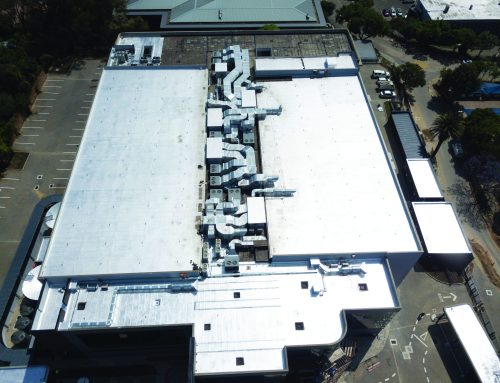
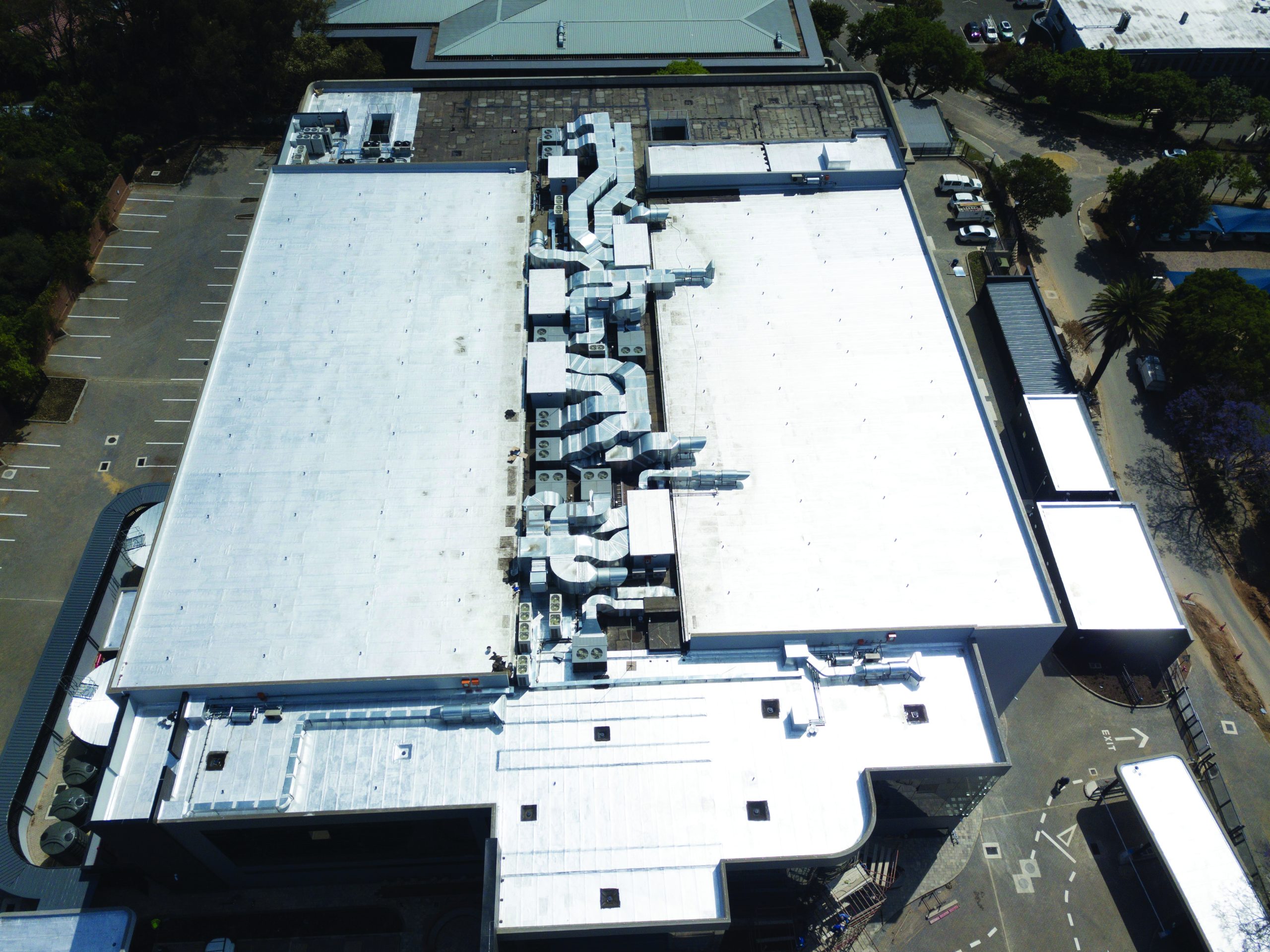
In Lydenburg, Mpumalanga, a significant energy-saving initiative is underway that promises to redefine hot water solutions for large institutions. Derick Gomez, director of MD Airconditioning, is at the forefront of this project, supplying and overseeing the installation of 80 cutting-edge heat exchanger units at the largest school in the area, aiming to drastically reduce its electrical consumption.
While this project is fundamentally about providing efficient hot water, it achieves this through an innovative application of air-conditioning technology and equipment.
The project emerged from a critical need to curb the substantial energy demands of the Lydenburg High School’s dormitories, which house numerous geysers providing hot water for students and staff. MD’s heat pump technology was chosen over competitors, including well-known combo units, primarily due to its superior efficiency, competitive pricing and cost- effective maintenance, he says. “He won the tender in terms of price and the efficiency of the product,” Gomez notes, referring to his client, the local air-conditioning contractor Cool-Air, which handled the installation. The entire Lydenburg community is keenly observing the outcome, as the school serves as a central hub for many families.
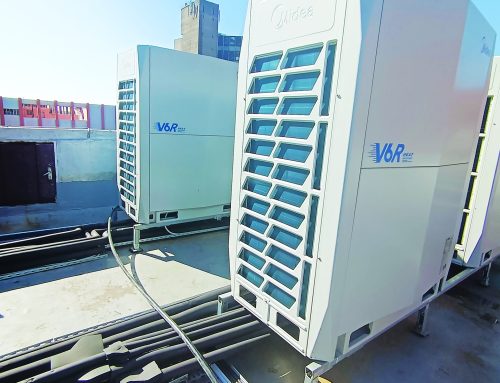
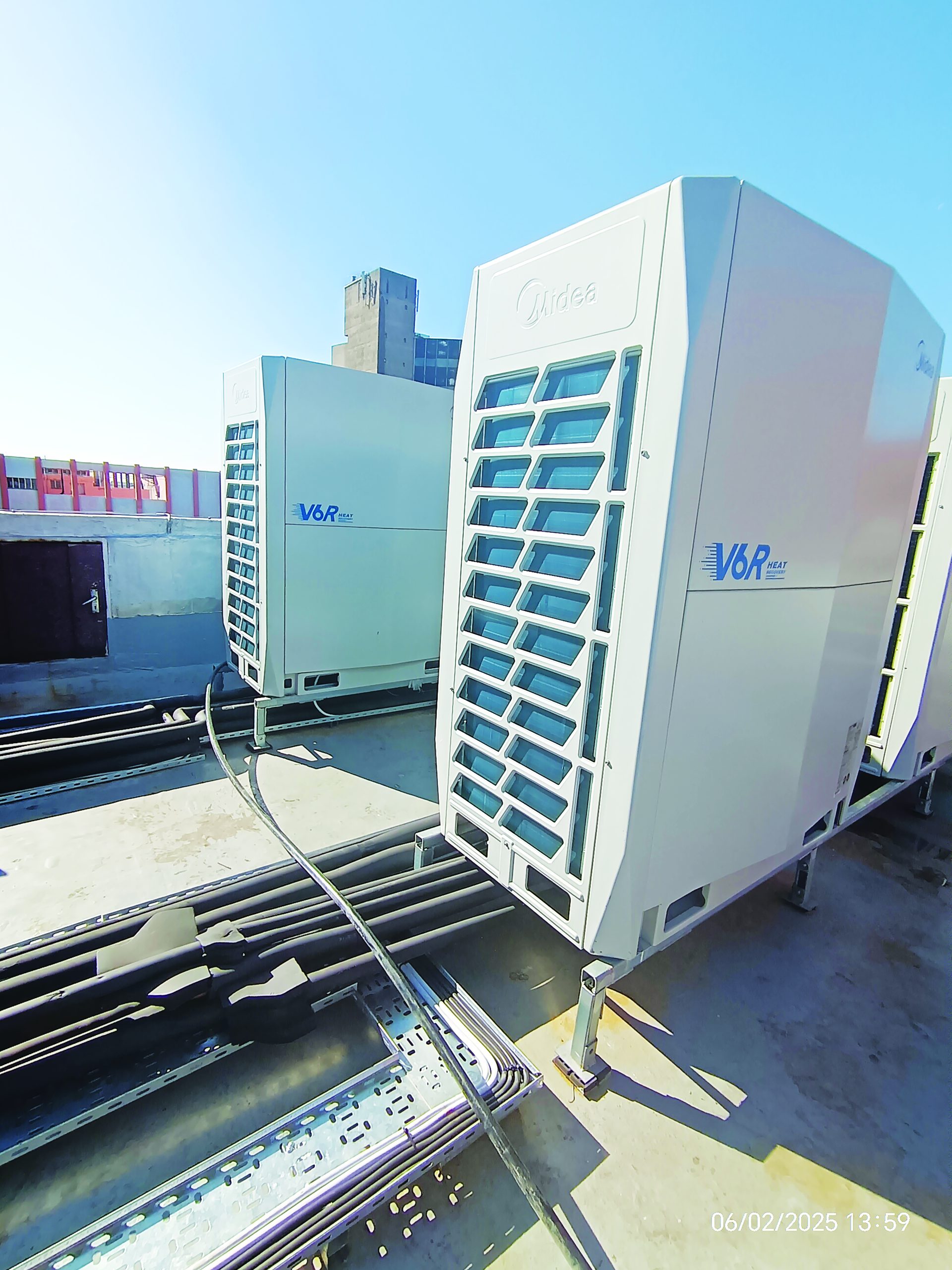
At the heart of this project lies Gomez’s proprietary heat pump design, an innovation he developed several years ago. Unlike conventional systems that pump water from the geyser to an external condenser for heating, Gomez’s technology takes a different approach. It utilises a standard air-conditioning unit’s refrigeration cycle to heat the water directly inside the geyser tank. “It actually is an air-conditioning unit in that you use its refrigeration cycle to heat the water in your tank,” Gomez explains. This means a normal 9 000BTU or 12 000BTU air- conditioning condenser is paired with a specially manufactured heat exchanger. The existing electrical element and its flange are completely removed from the geyser, and the heat exchanger is fitted in its place, transforming a conventional geyser into a highly efficient heat pump system.
The advantages of MD’s system are multifold. With an impressive Coefficient of Performance (COP) of up to 5.6 – this project achieves 4.1 according to live readings as the test was done coming out of winter with cold tap water affecting performance – it stands out against competitors. From a cost perspective, the supply and installation of one of these units is less than half of other heat pump geysers on the market, he says.
Beyond the initial outlay, the long-term savings are substantial. A key benefit is the reduced repair and maintenance cost. Should any component fail, a standard air-conditioning condenser is cheaper and more readily available to replace than parts for more specialised, integrated heat pump geyser units.
The energy savings are particularly compelling for a large institution like the school. Traditional geyser elements typically consume 3–4kW of electricity. In stark contrast, MD’s heat pumps operate at a mere 700–800W. This dramatic reduction translates into immense monthly electrical savings for the school. Gomez estimates that with his product, “customers typically see their investment recouped within a remarkably short period, usually a year and a half or less”.
Learning from a phased rollout and independent verification
The project commenced with an initial pilot of ten units, which were rigorously tested. To ensure complete transparency and to validate the performance claims, the school has engaged an independent electrical engineer – Theo van Wyk, owner of ENFENERGY – who has no affiliation with either MD
Airconditioning or the installer Cool-Air. This third-party engineer meticulously took readings, measuring amperage and verifying the units’ consumption and performance. His report is provided below.
As Gomez asserts, “These are readings from a live working project, highlighting the real-world, unbiased nature of this verification process, which contrasts sharply with controlled laboratory tests. Upon completion of this initial phase, factual data on energy consumption and savings became available, providing concrete evidence of the system’s efficacy.” Gomez personally oversaw the installations in Lydenburg to ensure adherence to stringent standards.
The school project’s fundamental objective was to mitigate excessively high electricity costs. After evaluating various options, including solar and gas, Gomez’s heat exchanger system was selected as the optimal solution due to its superior energy consumption efficiency. It proved more cost-effective than current gas alternatives and significantly outperformed solar water heating. Gomez emphasises that traditional solar systems often fail to deliver consistent savings because their electrical elements activate during peak morning and evening hot water demand, when sunlight is absent, negating daytime solar gains. In contrast, his heat exchanger pumps offer consistent energy savings irrespective of sunlight availability. Furthermore, potential future scarcity and rising costs of LP gas in South Africa could further solidify the economic advantage of electric heat exchangers.
Addressing the Lydenburg climate, Gomez explains the fundamental principle behind his heat pump: it extracts energy directly from the ambient air and transfers this energy to heat the water in a geyser. This process leverages the existing ‘hot side’ of an air conditioning unit’s refrigeration cycle. A key innovation in Gomez’s design is the use of liquid refrigerant to heat the water, a technique he notes he was employing even before it became a trend in newer air conditioning technologies for longer pipe runs. The system uses R410a refrigerant.
Gomez strongly advocates for simplicity being the “height of sophistication”. By removing clutter – multiple controls, switches and sensors that increase production costs and are prone to breaking – his design gets “as close as we can to the law of thermodynamics”.
“This minimalist approach is directly responsible for achieving the system’s remarkably high 5.6 COP, contrasting sharply with typical air conditioning units (3.8–4.8 COP) and even other heat pumps. This efficiency means that if the system is designed and installed correctly, it simply works, without the need for additional complex components.”
The inherent simplicity also means the system is adaptable. While its primary function is hot water generation, Gomez notes that with “a slight modification”, it could be used for cooling or air conditioning, showcasing its versatility.
A core tenet of Gomez’s operation is his commitment to South African quality and local sourcing. While the outdoor condenser units are imported, the critical components of his heat exchanger are domestically sourced: the copper coil is made from South African copper manufacturer Maksal, and the stainless steel flange from South African 316 stainless steel. He acknowledges that these local materials are “a bit pricey, but it’s quality”, a direct response to negative experiences with imported Chinese products that “didn’t last” and showed signs of rust within their copper coils.

Design philosophy – learning from the basics
Gomez reiterates the simplicity and effectiveness of his system: “We remove the elements and fit our heat exchanger – so there is no element whatsoever on the geyser. It’s just a tank with a refrigeration coil.”
He underscores several unique elements that make his product special:
- Element removal: directly replacing the geyser’s element with his heat exchanger
- Liquid refrigerant: using liquid refrigerant for heating, which enhances efficiency
- Extended pipe runs: the system can accommodate outdoor unit distances of up to 15m from the geyser without needing to upsize the machine, unlike many other heat pumps that require upsizing beyond 7.5m or 10m
- ‘Inverter-like’ performance: the system starts with a relatively low amperage of around 2.9 amps when water is cold, and gradually increases as the water temperature rises, mimicking an inverter’s efficiency without the added complexity. This principle is derived from the observation that submerging a running condenser in water causes its gas pressure and amps to drop
His background in air conditioning and refrigeration contrasts with the common trend of plumbers installing heat pumps. Gomez argues that plumbers are often unqualified to repair heat pump components like compressors or heat exchangers, leading to calls to refrigeration specialists when breakdowns occur. He observes a growing convergence between the plumbing and air-conditioning industries, especially as plumbing projects increasingly incorporate sophisticated air-conditioning technologies like his heat pumps.
Power savings at Lydenburg high: future lessons in energy use
Stefan Schwan, project manager and owner of Cool-Air in Lydenburg, adds: “When Lydenburg High School set out to cut down its electricity use, six companies lined up with competing proposals. After careful evaluation by both the school board and an independent electrical engineer, one solution stood out: the MD heat exchanger.”
Unlike conventional systems, the MD heat exchanger offered two decisive advantages – efficiency and ease of maintenance. For a boarding school with high hot water demands, this was critical.
A standard 200ℓ geyser with a 4kW element consumes around 18 amps. In comparison, the MD heat exchanger slashes this requirement to just 2.9 amps by operating at 700 watts. The result is dramatic power savings – something that was confirmed not only by internal testing but also through the independent audit.

“I tested it myself, but to remove all doubt, we brought in an independent auditor who verified the numbers. The savings are real,” emphasises Schwan.
The aim of the first phase of the project – designed as a pilot, involved installing 10 heat exchangers – was to test ease of installation, monitor performance and validate the savings before scaling up.
The outcome exceeded expectations. Installation was straightforward, requiring no specialised skills beyond standard geyser or air-conditioner fitting. Maintenance proves equally simple: the MD heat exchanger avoids the use of sensitive PC boards, which are prone to failure during frequent municipal power cuts.
“With this system, you eliminate the risk of burnt boards. This means if one technician moves on, another can step in without difficulty. Everything is standard and locally available.”
With the pilot deemed a success, the school board is preparing to install 27 additional units in the next phase, before rolling out across the full campus of 80 to 84 units. The cost-benefit analysis and verified data convinced decision-makers that the system will pay for itself within a short period.
“This isn’t just another minor tweak on an existing product, it’s a genuine innovation. For me, it’s a ‘wow’ factor,” says Schwan.
While the Lydenburg project showcases the system’s performance in an institutional setting, the MD heat exchanger is also well-suited for households and small businesses. It can be retrofitted onto existing geysers, avoiding the need for costly replacements.
An independent test: marking the results
Theo van Wyk, owner of ENFENERG, oversaw the trial at Lydenburg High School, which compared a traditional 3kW geyser with a heat pump/exchanger system demonstrating how heat pump technology can slash electricity bills and reduce peak demand.
The results were striking. A conventional geyser drew up to 18 amps, while the heat pump used just 2.9 amps. “That translates to savings of about R1 800 to R1 900 per geyser every month,” Van Wyk explained. With roughly 80 geysers on campus and a monthly electricity bill exceeding R420 000, the potential for cost reduction is significant.
The unit tested achieved a coefficient of performance (COP) of around 4.1, meaning it delivered more than four times the heating compared to the energy it consumed. In practice, the system captures ambient heat and transfers it into the geyser via a refrigerant gas, rather than generating heat directly through resistance elements. This design avoids heat losses common in older systems and improves efficiency.
Van Wyk noted that the technology also reduces maximum demand charges. When hostel geysers often all switch on simultaneously during peak shower times, they drive up the school’s load. “If enough units are converted, the maximum demand will come down too – adding several hundred rand in savings per geyser each month,” he said.
At about R17 000 per unit, the payback period can be less than a year, with warranties extending five years. Beyond schools, Van Wyk sees value for households and estates using solar. By cutting geyser consumption, fewer panels and smaller batteries are required.
For Lydenburg High, the maths is compelling. Even converting half of its geysers could save R70 000 to R100 000 monthly. “It’s really a no-brainer,” van Wyk said. “With these systems paying for themselves so quickly, the long-term savings free up resources for education rather than electricity.”
How the heat exchanger gets top marks on delivering more hot water for less power
While traditional electric geysers rely on resistance elements to generate heat, a heat pump/exchanger works on a different principle: it moves heat rather than creating it.
“The easiest comparison is to your household air conditioner or refrigerator. An element needs one watt of electricity for every watt of heat it produces. A heat pump, on the other hand, uses a small amount of electricity to shift heat from one place to another,” says Van Wyk.
In practice, the system pulls heat from the surrounding air. A refrigerant gas absorbs this ambient warmth, then gets compressed. That compression raises the temperature, and the hot gas is piped directly into a coil inside the geyser. The coil acts as a heat exchanger, releasing the captured heat into the water.
This design is different from older heat pumps, which pumped water to and from the unit. “By taking the refrigerant directly to the geyser, we avoid those heat losses and improve efficiency,” Van Wyk explains. The result is a higher COP – the measure of how much heat is delivered compared to the electricity consumed.
The benefits go beyond efficiency. Because the hot refrigerant coil sits inside the geyser, the risk of limescale build-up is reduced compared to water-based systems, extending the lifespan of the equipment. Maintenance is simple: mainly cleaning or replacing the exchanger if efficiency drops.
There are performance limits: the higher the set water temperature, the harder the pump must work. “Getting from 20°C to 60°C is straightforward. But pushing to 70°C is like driving at 160 km/h instead of 120 – it takes more energy.” Still, in normal use, the system consistently outperforms electric elements.
The simplicity of the design also means fewer moving parts. Essentially, it’s an outdoor unit similar to an air conditioner, paired with the internal heat exchanger coil. “That’s why this combination is so efficient – it just moves heat, it doesn’t need to create it,” Van Wyk concludes.