By Eamonn Ryan
Minimum Energy Performance Standards (MEPS) for electric motors are reshaping the way South African industry – and especially the HVAC&R sector – approaches energy efficiency.
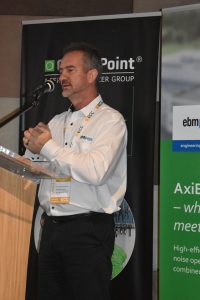
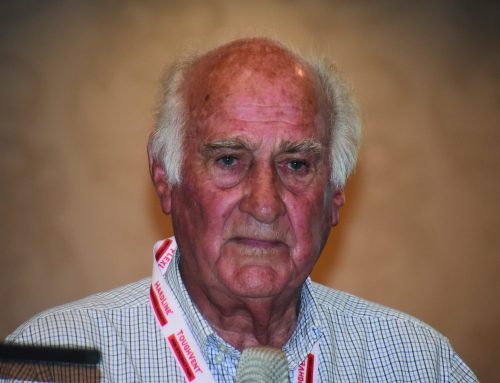
Francois Schoombie, technical
director, ebm‑papst South Africa,
recently gave a presentation in Cape
Town on ‘MEPS compared to fan
performance, ascertaining system
efficiency’. © RACA Journal
On the surface, the move to higher-efficiency motors appears to be a straightforward compliance exercise. In reality, it has far-reaching implications for plant design, operating cost and long-term resilience.
Schoombie explores why simply complying with IE3 motor requirements captures only a small fraction of the available savings. The real opportunity lies in understanding fans as complete systems and in adopting EC (electronically commutated) technology that enables true optimisation.
South Africa’s MEPS framework introduces minimum energy performance standards for new industrial motors in the range of 0.75 kW to 375 kW. This covers the vast majority of motors used in industrial and commercial equipment. Motors are estimated to consume about half of industrial electricity, and in many HVAC and refrigeration facilities, fans and their drives can account for 30–50% of total plant energy use. Motor-driven systems account for ~53% of global electricity consumption.
The national target of cutting electricity demand by a fraction of a percent may seem modest, but when over half of that demand is motor-driven, even small percentage improvements translate into large absolute savings. The aim of MEPS is to eliminate the worst performers from the market, align South Africa with international best practice and establish a higher baseline for new installations.
In refrigeration applications, where equipment often runs 24 hours a day, seven days a week, these incremental improvements are multiplied over thousands of hours, turning seemingly small efficiency gains into substantial financial savings.
WHAT IE3 MOTORS DELIVER – AND WHAT THEY DON’T
Under the new regulations, IE3 becomes the minimum efficiency class for most new motors in scope. Replacing older IE1 or IE2 units with IE3 typically yields 5–8% energy reduction in practical applications, translating into about 5–10% less electrical energy for the same mechanical output.
Less input power is needed for the same airflow. The motor produces less waste heat, which is particularly important in refrigerated spaces where every additional watt of heat ultimately has to be removed by the refrigeration system. Cooler running motors also tend to last longer, reducing failure rates, maintenance interventions and unplanned downtime.
However, these are component-level improvements.
A fan system consists of much more than just a motor.
The efficiency of the belts or couplings, the fan impeller’s aerodynamics, the control strategy and the way the system is loaded over time all play critical roles. If only the motor is improved while everything else remains unchanged, the overall efficiency gain is inherently limited.
Schoombie uses the concept of an “efficiency chain” to describe this reality. The motor, transmission, fan impeller and control system each have their own efficiency. The overall system efficiency is effectively the product of these individual stages.
From an engineering perspective, the lowest efficiency stage often dominates the final result.
For example, upgrading a motor from 85% to 90% efficiency is a worthwhile component improvement.
But if that motor still drives a belt system with around 15% losses, turning a fan that is poorly matched to its duty point and controlled at constant speed against dampers, the net effect on overall system performance is relatively modest. The belt losses, aerodynamic mismatches and control inefficiencies remain untouched.
As a result, replacing an IE1 or IE2 motor with an IE3 motor in a traditional belt-driven, constant-speed system may only realise a small portion – sometimes around 20% – of the savings that could be achieved if the entire fan system were optimised. Treating MEPS as an end goal, rather than the starting point, up to 80% of potential savings remain unrealised.
THE COMFORT OF LIKE-FOR-LIKE REPLACEMENT
In day-to-day practice, the most common response to a failed or ageing motor is a like-for-like replacement. The plant removes the old motor, fits a new one with the same power rating and mechanical dimensions, and ensures that it meets the IE3 requirement. From a contractor’s and operator’s perspective, this approach is simple, predictable and compliant.
There are understandable reasons for this pattern. A motor swap is the lowest visible cost option. Technicians are familiar with installing and maintaining conventional induction motors. Perhaps most importantly, downtime is often critical: a quick motor change is perceived as safer than a more intrusive retrofit which may require longer outages and additional co-ordination.
The drawback is that this approach does little to address the underlying inefficiencies in the fan system. The belts still introduce losses and maintenance requirements. The fan still runs at constant speed, with airflow controlled by dampers or crude on–off cycling. Oversizing and mismatches between fan output and actual cooling demand remain. In short, you may achieve compliance and a small reduction in consumption, but you miss the opportunity for transformational savings.
To unlock those larger savings, Schoombie argues for a shift to EC fan systems: electronically commutated, permanent magnet motors integrated with high-efficiency fan impellers and onboard variable speed drives. EC motors are significantly more efficient than IE3 induction machines, often reaching IE4 or IE5 equivalent levels, and are generally used in direct-drive configurations that eliminate belt and pulley losses entirely.
The real advantage, however, lies in how EC fans operate under part load. Fan power follows the well-known cubic relationship with speed. If airflow requirements drop and the fan can slow down, power consumption falls disproportionately. Halving the fan speed roughly halves the airflow, but cuts the power draw to about one eighth of full-speed consumption.
Traditional systems often respond to lower load by closing dampers or cycling fans on and off. Both approaches waste energy or degrade control. EC fans, by contrast, can continuously adjust speed to match the actual cooling demand. In many applications, this allows average fan speeds to be reduced for large portions of the day, yielding fan energy savings of 30–50% compared to conventional solutions.
In addition, EC fans are increasingly deployed in arrays of smaller units rather than as a single large fan. This provides built-in redundancy: if one fan fails, the others can increase their speed to maintain airflow and protect product. Integrated electronics handle soft starting, protection functions and monitoring. Many EC fans offer onboard temperature sensing, vibration monitoring and energy metering, which can be linked directly into the building management or supervisory control system.
QUANTIFYING THE OPPORTUNITY
To make the comparison concrete, consider a 5kW evaporator fan motor running continuously in a freezer. Over a year (8 760 hours), the baseline energy use is around 43 000kWh. If an older 85% efficient motor is replaced with a 90% efficient IE3 motor, the annual energy consumption falls by about 6%, to roughly 40 000kWh. At an electricity tariff of R2.50 per kWh, that saving equates to approximately R7 500 per year – welcome, but relatively modest for a continuously running load.
Now compare that to a full EC retrofit. A direct-drive EC fan with IE5-class motor efficiency and integrated variable speed control, properly matched to the evaporator and its load profile, can realistically bring annual consumption down to around 20 000–25 000kWh. That represents approximate savings of 40–50% reduction from baseline, and roughly six times the saving achieved by the IE3 motor-only swap.
Over a five-year period, this difference accumulates to roughly 90 000kWh more saved by the EC solution than by the compliance-only option. At the same R2.50 per kWh, that is around R225 000 in additional avoided energy costs, before even considering knock-on benefits such as lower compressor run times or reduced maintenance.
LOCAL CASE STUDIES: MEASURED PERFORMANCE
These calculations are supported by real-world data from South African facilities. In one large distribution centre in Johannesburg, condenser fans originally driven by IE2 motors with simple on–off control were retrofitted with EC fans operating under variable speed control. Measured results showed a 40% reduction in fan energy consumption, with a payback of around two and a half years based purely on energy savings. On the strength of this, the operator began rolling the solution out across other sites.
In another Johannesburg cold storage warehouse, 40kW evaporator fans were replaced with high-efficiency EC ‘black’ fans.
The retrofit delivered approximately 35% savings in fan energy and improved temperature uniformity in the cold rooms. Because airflow and temperature control were better matched to the actual cooling requirement, compressor runtime could also be reduced. The simple payback period was about three years, but when the project qualified for Section 12L energy efficiency tax incentives, this shortened to roughly 2.2 years.
OVERCOMING BARRIERS TO ADOPTION
Despite the strong technical and financial case, adoption of EC and advanced fan systems has been slower than might be expected. Schoombie points to several recurring concerns that need to be addressed.
The first is upfront cost. EC fan assemblies typically cost between one-and-a-half and three times as much as a simple motor replacement. Looked at in isolation, this premium can be off-putting. However, when the full life-cycle is considered, it becomes clear that 90–95% of a fan system’s cost over 10–15 years is actually energy consumption, not capital expenditure.
Short paybacks and tax incentives significantly soften the impact of higher initial prices. Consider the procurement mindset shift, capex versus opex trade-off.
Downtime is another concern. Operators are understandably reluctant to risk extended outages in critical cold rooms. Here, careful planning and modular product design are key. EC solutions can often be implemented in phases, fan by fan or block by block, using drop-in retrofit modules that match existing footprints and mounting arrangements. This allows upgrades to be scheduled during planned maintenance windows without compromising product.
There are also questions about technical compatibility and robustness. Historically, EC technology was mainly associated with smaller fans, but today axial EC fans are available in diameters up to around 1 600mm, with a range of options capable of delivering the higher static pressures required in demanding applications. Modern EC systems are designed for industrial environments, with comprehensive protection against voltage disturbances, phase loss, locked rotor and overheating.
When faults do occur, the fan typically enters a protective state rather than failing catastrophically, and diagnostic information can be fed back to maintenance teams.