By Eamonn Ryan
A practical look at how HVAC&R controls have evolved — from electromechanical systems to intelligent, integrated platforms shaping the future.
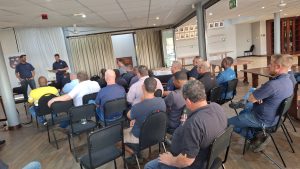
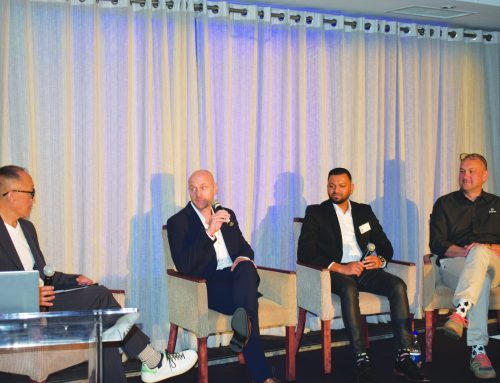
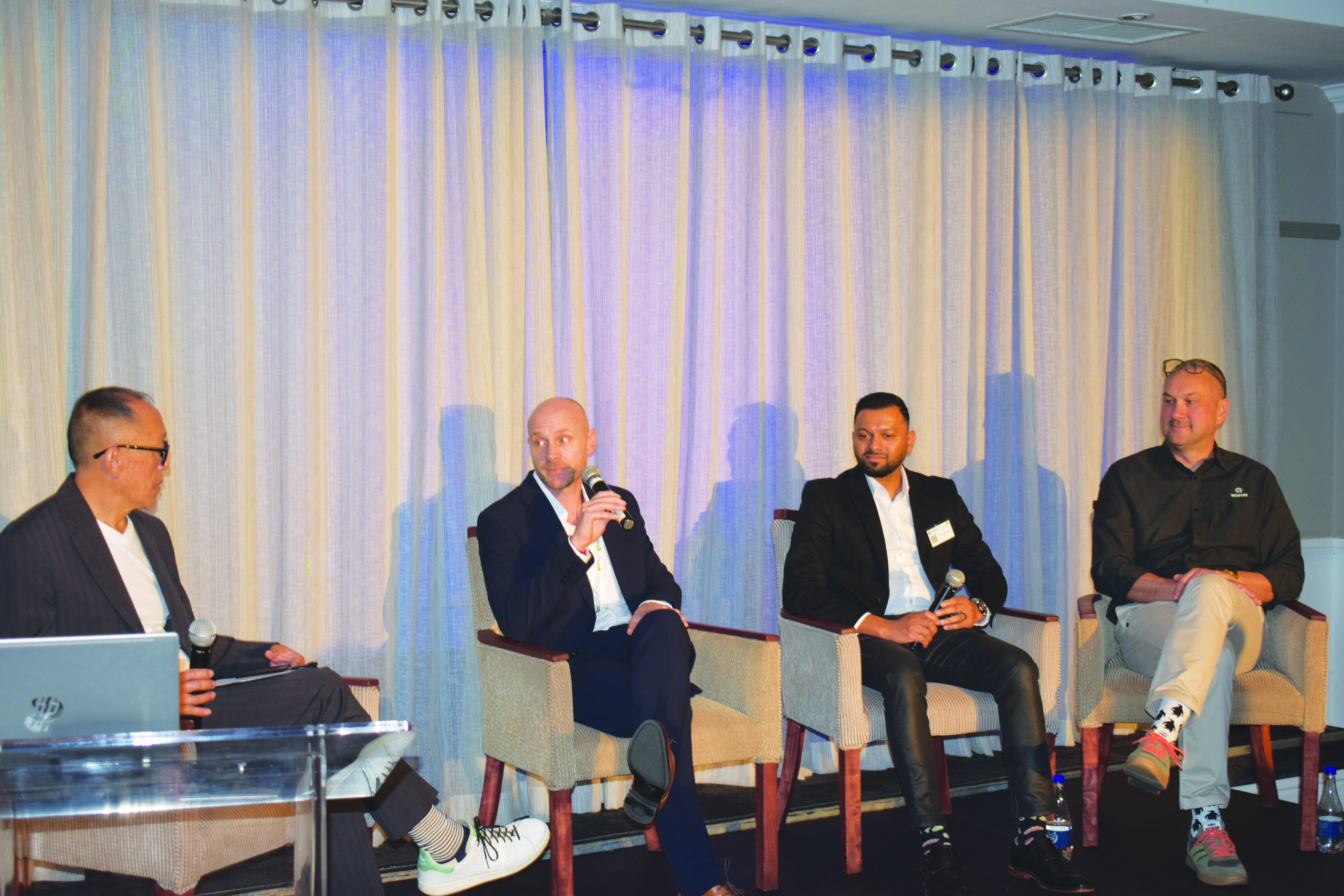
A technical demonstration during the January 2026 Cape Town TechTalk showing PLC-based HVAC&R control logic and system integration principles in practice. © RACA Journal
At the January 2026 Cape Town TechTalk, Ben Milne, Western Cape manager at Keystar Industries, delivered a practical presentation on PLC-based HVAC and refrigeration controls. Drawing on more than two decades of hands-on experience in refrigeration, HVAC controls, ammonia and CO₂ systems, fault finding and technician training, Milne set out to strip away much of the intimidation surrounding PLCs (Programmable Logic Controllers) and modern electronic controllers, replacing it with clear fundamentals and real-world context.
Rather than approaching the subject from an academic or theoretical angle, the talk focused on how controllers are actually used in the field, why they exist, where technicians commonly go wrong and how the industry is rapidly moving towards integrated and intelligent systems.
Milne began by grounding the discussion in a reality familiar to anyone who has worked on older installations. Traditional control systems built around electromechanical thermostats, timers, delay relays and selector switches were robust but bulky, labour-intensive and increasingly impractical. Attempting to replicate the functionality of a modern controller using discrete components quickly results in large panels filled with wiring, increased installation time and a far higher risk of wiring errors.
In environments such as supermarkets, where a single store can contain dozens of cabinets, evaporators and fans, this approach is no longer viable. Electronic controllers dramatically reduce panel size, simplify wiring, shorten commissioning time and allow for functions that mechanical systems simply cannot perform. Electronic expansion valves, variable-speed compressors and fan modulation are now standard expectations rather than specialist features.
The shift to controllers was therefore not driven by fashion or complexity, but by necessity. Efficiency targets, energy costs, space constraints and system complexity all demand a more compact and intelligent approach to control.
- FROM MECHANICAL RESISTANCE TO ELECTRONIC ACCEPTANCE
Milne drew a parallel between the industry’s historical resistance to electronic controls and the hesitation many technicians now feel towards PLCs and advanced software-driven systems. Two decades ago, many contractors refused to work with electronic expansion valves, preferring the familiarity of mechanical alternatives. Today, electronic valves are commonplace, and technicians are expected to understand how to commission and fault-find them.
According to Milne, the industry is standing at a similar crossroads. PLCs, integrated monitoring and AI-driven analytics may seem intimidating, but they represent the next logical step in system evolution rather than a radical departure from established principles.
A key part of the presentation was clarifying the difference between standard electronic controllers and PLCs. Standard controllers are typically pre-programmed, certified and sold as finished products. Their development cost is spread across thousands of units, making them cost-effective and reliable for repeatable applications. These controllers arrive with known behaviour, manuals and defined operating parameters, which makes them ideal for the majority of HVAC and refrigeration applications.
PLCs, by contrast, are essentially blank devices supplied without application-specific software. Their strength lies in flexibility. They can be programmed to do almost anything, but that flexibility comes at a cost. Custom software must be written, tested, commissioned and maintained. If that knowledge is lost over time, the long-term risk to the end user can be significant.
Milne stressed that PLCs are not inherently bad or risky. The danger arises when custom programming is deployed without proper documentation, standardisation or long-term support. For this reason, Keystar actively promotes the use of standard, tried-and-tested solutions wherever possible.
At the January 2026 Cape Town TechTalk, Ben Milne, Western Cape manager at Keystar Industries, delivered a practical presentation on PLCbased HVAC and refrigeration controls.
Supplied by SAIRAC Cape Town Centre.
- INPUTS, OUTPUTS AND THE IMPORTANCE OF SIGNAL TYPES
At the heart of every controller, whether simple or complex, lies a straightforward concept: inputs regulate outputs. Milne unpacked this principle, as misunderstandings around inputs and outputs remain one of the most common causes of commissioning and fault-finding errors.
Analogue inputs provide continuously variable information to the controller. These include temperature probes, pressure transducers, humidity sensors and gas detectors. Depending on the sensor type, the signal may be resistance-based, a current loop such as 4–20mA, or a voltage signal such as 0-10Vdc or 0.5-4.5Vdc. Each has its own advantages and limitations, particularly in terms of noise immunity, cable length and accuracy.
He highlighted calibration as a critical but often neglected aspect. Small errors introduced by cable resistance or poor installation can have a disproportionate impact on system performance. In many cases, simple field calibration methods, such as ice-water testing for temperature probes, are sufficient to achieve acceptable accuracy.
Analogue outputs, on the other hand, allow controllers to modulate equipment rather than simply switch it on or off. These outputs drive variable-speed drives, inverter compressors, electronically controlled valves and fan speed controllers, enabling smoother operation and improved energy efficiency.
- DIGITAL SIGNALS AND SIGNAL FLOW DIRECTION
Digital inputs and outputs are binary in nature, operating in either an on or off state. Digital inputs are commonly used for functions such as unit enable, defrost initiation, standby operation or setpoint selection. Digital outputs typically drive relays, solenoids, contactors or alarms.
Many field problems arise not from faulty equipment, but from a lack of clarity about where a signal originates and where it should terminate. Milne emphasised the importance of understanding signal flow direction. Sensors generate outputs, controllers receive inputs, and outputs from controllers act on external devices. Transducers require power supplies, and relays should be used to protect controller outputs from high loads.
Using an air handling unit example, Milne illustrated how theory translates into practice. A mains supply is stepped down to a 24V control circuit, a static pressure sensor feeds an analogue input, and the controller modulates a supply fan to maintain duct pressure. Multiple temperature probes are used for both control and safety, while interposing relays ensure that expensive controller outputs are protected from electrical faults.
This example reinforced the idea that good control design is as much about sound electrical practice as it is about software.
- PLC PROGRAMMING WITHOUT THE MYSTIQUE
To further demystify PLCs, Milne demonstrated basic programming using the Eliwell Free Studio Plus platform. Rather than focusing on complex code, he showed how function blocks can be arranged in a way that closely resembles traditional wiring diagrams. Logic flows from left to right and top to bottom, making it easier to understand and fault-find.
A simple thermostat was built step by step, incorporating a temperature setpoint, an analogue input, a calibration offset, comparison logic and a digital output. Simulation tools allowed the logic to be tested in real time, providing immediate visual confirmation of how the system behaves.
While acknowledging that a simple on-off thermostat is insufficient for most real applications, Milne used the example to introduce more advanced concepts such as differential control and PI (Proportional-Integral) regulation, which are already embedded in many standard controllers.
Modern controllers rarely operate in isolation. Modbus communication allows controllers to exchange data with monitoring systems, energy meters and other devices. Each variable and parameter has a defined address, enabling integration without proprietary lock-in.
Monitoring systems provide historical trending, remote access and powerful fault-finding tools. However, Milne cautioned that these capabilities can also create unrealistic expectations of support, particularly when contractors rely on suppliers as a first point of troubleshooting rather than consulting documentation.
- THE DANGER OF UNMANAGED CUSTOM CODE
One of the most sobering messages of the evening concerned the long-term risk of custom programming. When programmers or commissioning technicians move on, undocumented logic can leave end users vulnerable. Imported equipment with locked OEM software and no manuals further compounds the problem.
For this reason, Keystar focuses heavily on standard solutions that are repeatable, documented and supported. Applications such as de-greening rooms, hatcheries, ammonia valve stations and CO₂ rack controllers are delivered with defined access levels, manuals and known behaviour.
The talk concluded with a look towards the future. Many facilities still operate as ‘islands of automation’, with racks, evaporators and condensers controlled independently. The next step is system-wide integration, allowing these subsystems to communicate and optimise performance collectively.
Artificial intelligence is already beginning to influence this space, offering early fault detection, predictive maintenance and energy optimisation. Tools such as ChatGPT are changing how technicians learn, diagnose faults and even generate control logic.
Milne stressed that while technology will continue to advance, systems must remain understandable and serviceable. Controls should support technicians, not overwhelm them, particularly when fault-finding under pressure.
The central message of the presentation was that modern controllers and PLCs are not mysterious black boxes. They are logical extensions of principles the industry has used for decades. By understanding fundamentals, embracing continuous learning and maintaining a healthy respect for standardisation, the HVAC&R sector can confidently navigate the next phase of control system evolution.
© RACA Journal