Compiled by Eamonn Ryan
Chillers are becoming the backbone of South Africa’s cooling market, driving efficiency, sustainability and reliability across data centres, mines and commercial buildings. Smart controls, low-GWP refrigerants and AI- driven monitoring are reshaping the industry for a greener, more future- ready HVAC landscape.

Levi Bands, director of Service First, a Trane distributor. Supplied by Service First
According to a Market Research Future publication South Africa Chillers Market Industry Trends, Growth Opportunities, and Forecast 2024-2032, the South African chillers market is undergoing a period of steady expansion and technological transformation, positioning itself as a crucial player within the broader HVAC industry. This growth is being propelled by a convergence of factors including climate conditions, a diversified industrial base, rising urbanisation and the increasing demand for energy-efficient cooling solutions. As industries such as manufacturing, pharmaceuticals, food and beverage and data centres continue to scale, the need for reliable, cost-effective cooling infrastructure becomes ever more essential in the South African context.
High ambient temperatures across much of South Africa significantly drive the demand for chillers, especially in commercial and industrial settings. This climatic pressure is paired with a growing need to comply with environmental regulations and reduce operational costs, prompting a shift towards energy-efficient solutions.
In response, major global players like Carrier, Trane,York and Daikin are tailoring their product offerings to meet local requirements, incorporating smart controls and low-GWP (Global Warming Potential) refrigerants to address the twin priorities of sustainability and performance.

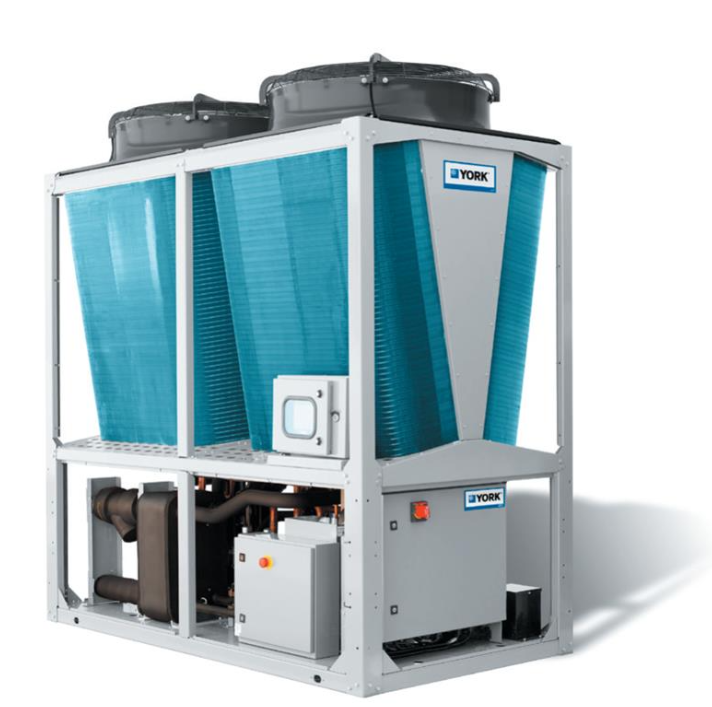
York air-cooled modular chillers. Supplied by Airotech
From a financial perspective, the South African chillers market was valued at R78-billion in 2023 and is expected to grow to R100-billion by 2032, registering a compound annual growth rate (CAGR) of 3.5%. This trajectory is underpinned by rising industrial demand, urban development and the government’s evolving industrial policies, which encourage modernisation and energy efficiency.
One of the strongest growth drivers is the push for energy-efficient technologies. Industries increasingly prioritise systems that reduce energy use and operational costs while adhering to environmental mandates. This has led to the adoption of advanced features like variable frequency drives (VFDs), high-efficiency compressors and IoT-enabled systems. Smart chillers, which allow for real-time monitoring, predictive maintenance and data-driven optimisation, are becoming increasingly prevalent.
Environmental considerations also play a central role in the market’s evolution. Traditional refrigerants are being phased out in favour of more sustainable options like HFOs and natural refrigerants (CO₂ and ammonia), which offer lower GWP and improved ecological profiles. These innovations are not just about regulatory compliance they also represent a shift in consumer and corporate priorities toward sustainability.
Challenges do remain, however. High upfront costs, complex installation requirements and ongoing maintenance demands can inhibit adoption, especially in less developed regions. Refrigerant management also remains a technical and environmental hurdle. Still, these challenges present opportunities for innovation. Companies that focus on affordability, ease of use and environmental compliance stand to benefit from the market’s growing demand for smart, green cooling solutions.
The coming decade will likely see further integration of smart technologies, environmentally responsible design, and product diversification as the market continues to mature.

What is a chiller – and how is it different from a heat pump?
As energy efficiency, connected systems and environmental considerations reshape HVAC priorities,York chillers, distributed by Airotech through Johnson Controls, are raising the standard for smart, adaptable and efficient cooling.
At a glance, chillers and heat pumps share a lot of DNA. In fact, a heat pump is essentially a reversible chiller. “A chiller produces cold water to cool a building, while a heat pump can reverse the cycle to produce hot water,” says Gert Deale, sales manager: Airotech. “In some systems, one unit can do both.”
York chillers operate by circulating chilled water, often around 6°C, through a building’s air handling units, which then cools the air inside. In contrast, during winter months or in systems with heat recovery, a reversible model can supply hot water to provide space heating.
York chillers come in a wide range of capacities, from small installations of around 10kW to industrial-grade systems exceeding 20MW. The latter are ideally suited for commercial properties, hotels, industrial facilities and data centres.
In larger buildings, it’s common to install multiple chillers for redundancy. “You’ll usually find at least two units in big systems so that if one fails, the other can still keep the building operational.” York offers both air-cooled and water-cooled chiller configurations, each with its own advantages:
- Air-cooled chillers are simpler to install and more common in green building certifications, thanks to reduced water usage
- Water-cooled chillers are more energy-efficient, but involve more complex infrastructure, including cooling towers and water treatment systems
Despite their superior performance, water-cooled chillers are less favoured in modern green building initiatives due to concerns about water consumption. “That might be a bit short- sighted. If you look at the full picture – energy use, emissions and water usage – water-cooled chillers are perhaps the better long-term choice.”
York chillers now come with connected capabilities, enabling remote monitoring, predictive maintenance and performance optimisation. “You can log in from anywhere in the world to check system status, detect faults early and even adjust operations,” says Deale. This not only minimises downtime but also helps reduce energy consumption by ensuring the system is running at optimal efficiency.
“One of our most recent launches was theYORK model YVAM. It is an air-cooled magnetic bearing centrifugal chiller that is specifically designed for hyperscale and colocation data centre applications.”
York chillers also support low-GWP refrigerants, helping customers comply with tightening international regulations. Deale explains that refrigerants like R513B, R1234ze, R1233zd and R515B are already available across York’s product lines. Natural refrigerants like R290 and ammonia are also available in our chillers, which is perhaps going to be a growing requirement in future.

York air cooled screw chillers – capacities from 525–2000kW, options with Screw or Centrifugal compressors. Supplied by Airotech
Chillers core to SA’s cooling market
South Africa’s cooling market is shifting rapidly, with demand for chillers rising across data centres, mining, industrial processes and commercial buildings. According to Levi Bands, director of Service First, a Trane distributor, chillers are increasingly central to conversations around efficiency, sustainability, and digitalisation.
“Different sectors are expanding at different rates, but chillers are the common denominator,” says Bands.
In data centres, the surge in artificial intelligence is creating unprecedented cooling loads, making high-performance chillers indispensable. Mining is also fuelling demand, both locally and across Africa, as projects for gold, platinum and copper operations grow.
Even the commercial market, which slowed during the COVID years, is rebounding. “Office refurbishments and upgrades are coming back, and hotels are finally replacing and upgrading chiller systems after years of deferring maintenance. Across all these sectors, chillers are the backbone of climate control,” Bands notes.

AquaForce variable-speed, air-cooled screw chiller 30XV. Supplied by Carrier
A strategy built around chillers
Service First’s strategy is clear: expand the installed base of Trane chillers while tailoring solutions to sector-specific needs.
“We’re focusing strongly on mining and data centres, where chiller requirements are both mission-critical and growing. At the same time, we’re broadening our approach – integrating chillers with other HVAC technologies, like VRF, to give clients the best possible balance of performance and efficiency,” explains Bands.
Trane’s global EcoWise portfolio – featuring Sintesis air- cooled chillers with next-generation refrigerants like R-513A and R-1234ze, and CenTraVac water-cooled chillers with ultra- low-GWP options such as R-514A and R-1233zd – is reshaping the market.
“These chillers are being well received in South Africa.
Efficiency and sustainability are no longer secondary – they’re drivers. Clients want chillers that comply with upcoming refrigerant phase-outs and that deliver lower lifecycle costs,” says Bands. The phase-out of HFCs means chillers are at the forefront of regulatory compliance. “Factories are already moving away from HFC-based chillers. If you specify a chiller today with an old refrigerant, you may struggle with supply and servicing in the future,” he cautions. Obsolete refrigerants may become unavailable or prohibitively expensive. “If you’re putting in a chiller today, it must be future-ready. Otherwise, you’re locking yourself into higher costs down the line.”
Chillers are also becoming smarter. With Trane’s Tracer Ensemble and Symbio controllers, remote monitoring and predictive diagnostics are now part of chiller management, says Bands.
“Having remote oversight of chiller performance allows us to identify issues early, optimise efficiency, and avoid unnecessary downtime. This is especially important for chillers installed in remote African projects, where onsite support can be difficult. A well-managed chiller plant, monitored digitally, saves both money and risk for the client.”
Artificial intelligence is set to accelerate this trend, making chiller operations even more efficient, reliable, and data-driven.

York Water cooled screw chiller – capacities from 400–2000kW. Supplied by Airotech
Choosing between air-cooled and water-cooled chillers
South Africa’s water scarcity has pushed many clients toward air- cooled chillers. “Over the last 10 to 15 years, we’ve seen a major swing away from water-cooled systems. Water-cooled chillers are inherently more energy-efficient, but in our context, water is simply too precious to waste.”
That said, water-cooled chillers still have a place, particularly for very large plants where energy efficiency is critical. “It’s always a trade-off. We engage consultants and end-users to weigh the balance: saving electricity with water-cooled systems, or saving water with air-cooled systems. Every chiller installation must be assessed case by case,” says Bands.
Despite the strong growth potential, hurdles remain in bringing chillers to more facilities. The most pressing is upfront cost.
“Chillers represent a significant capital expense, and South African businesses are cost-conscious,” says Bands. “Our role is to help them see the bigger picture.
A slightly higher investment upfront in a more efficient chiller can yield major savings in energy and operating costs over the next 10 or 15 years.” Here, education is key.
Maintenance and servicing are also challenges, especially in remote areas.
Here again, remote monitoring of chillers provides a solution, allowing Service First to diagnose and even resolve issues without delay.
“The chiller market in South Africa is dynamic,” Bands concludes. “Yes, upfront cost and regulation are challenges. But demand is growing, technology is advancing, and clients are more aware than ever of efficiency and sustainability. Trane and Service First are well positioned to deliver chillers that meet today’s needs and tomorrow’s expectations.”

University of Stellenbosch chiller, a project featured in our August issue. Supplied by Two Oceans Air Conditioning
AI and IOT transform how chillers are maintained
As manufacturers and data centres continue to spend more on energy each year, chillers – being major energy consumers – have become a focal point for cost-saving and performance- improving strategies. Older systems tend to be inefficient and prone to failure, while newer chillers with smart controls and variable speed compressors offer better performance, reduced energy use and enhanced reliability. Real-time monitoring and data-driven adjustments allow facility managers to fine-tune operations and identify issues early, helping to lower operational costs and prolong equipment life.
Companies are actively seeking low-global- warming refrigerants and energy-efficient designs to meet environmental goals and comply with regulations. Eco-friendly chillers, such as those using natural refrigerants like CO₂ and propane (R290), are gaining popularity. These options significantly lower carbon emissions and improve efficiency. R290, for instance, offers 7% higher performance and nearly 100% fewer carbon emissions compared to traditional refrigerants like R404A.
Reliability remains a top concern, especially in sectors like manufacturing and data centres, where cooling is mission-critical.
New systems use smart sensors and predictive maintenance to prevent downtime. Backup chillers and remote monitoring ensure consistent performance, while AI-driven maintenance reduces failure rates and repair times, saving thousands annually and delivering fast returns on investment.
The industry is leaning toward modular and compact chiller systems. Modular designs offer scalability, allowing businesses to expand cooling capacity as needed without upfront overspending. Compact chillers, ideal for space-constrained environments, deliver high performance without requiring large footprints.
Reference: https://blog.arkref.com/industrial-chiller-trends-2025-manufacturing-data-centers/?utm

Chillers are more efficient at high-capacity loads, such as what is required at a hospital with 24-hour operation. © RACA Journal
Daikin keeps cool Norway’s largest data centre
Daikin has supplied 71 air-cooled free cooling chillers to Norway’s largest data centre, OSL-Hamar, owned by Green Mountain. Designed with sustainability and performance in mind, the facility maintains an impressive Power Usage Effectiveness (PUE) of 1.2 and is powered entirely by renewable hydropower.
Cooling at OSL-Hamar is provided by a water-based system where free cooling chillers feed chilled water to fan arrays, which regulate the temperature in the white space. The selected units – Daikin’s EWFH-TZ D air-cooled free cooling chillers – were chosen for their efficiency, compact design and operational reliability.
Each chiller is equipped with a Daikin-designed screw compressor featuring a VFD that modulates compressor speed to match the cooling demand. This results in significant energy savings, particularly at part load, while reducing mechanical wear and extending equipment lifespan. The VFD is refrigerant-cooled, allowing for stable operation regardless of ambient temperature, dust or humidity.
Daikin’s integrated Active Harmonic Filter also contributes to system stability by reducing total harmonic distortion (THD) to below 5%. This enhances electrical efficiency and helps protect critical infrastructure from power-related faults.
By integrating advanced chiller technology and controls, the OSL-Hamar data centre achieves both high energy efficiency and long-term operational resilience, setting a new benchmark for sustainable data centre cooling.
Reference: https://www.daikin.co.za/en_us/press-releases/daikinkeeping-cool-norways-largest-data-center.html