By Andre van der Merwe, managing director of Evapco South Africa
A key aspect of the company’s offering is its ability to provide a wide spectrum of products depending on the client’s application and operational requirements. This ranges from full evaporative cooling products to hybrid cooling solutions, adiabatic coolers and full dry coolers. These solutions can be applied across projects of all sizes, including hyperscale data centres.
Supplied by Evapco
In the US, the data centre market is growing at an unprecedented rate, resulting in massive demand for reliable cooling solutions. Data centres fundamentally require two critical components: power and cooling.
Evapco has designed cooling systems in the US for various clients, including Google, Microsoft, Amazon AWS, Meta, AirTrunk and Vantage, among others. Most of these projects are so-called hyper data centres requiring over 100MW of cooling capacity and above.
One example is the new Vantage Port Washington site. The development covers 672 acres across four stages and generates 902MW of load. Eco Aire Titan field-erected dry coolers are installed on each of the four buildings, supplying cooling to water-cooled chillers. The project is scheduled to be rolled out over three years.
COOLING TECHNOLOGIES AND CLIENT PREFERENCES
Each data centre client typically has its own preferred cooling solution design philosophy.
Amazon mainly utilises large open-type cooling towers combined with water-cooled chillers. Air-cooled chiller systems are currently the most preferred option and represent the majority of installations in the market, as demonstrated by the Vantage Port Washington project.
Some clients utilise a combination of water- and air-cooled solutions depending on cooling load requirements and climatic conditions, as seen in certain Microsoft projects. Increasing fluid temperatures at server level are also enabling some applications to eliminate chillers entirely and satisfy cooling requirements using adiabatic coolers only.
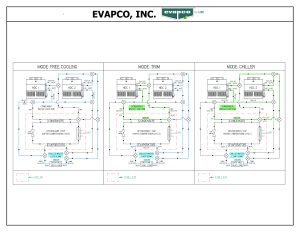
Evapco strongly promotes hybrid cooling systems or combination systems, which offer lower annual water consumption while maintaining optimum energy efficiency. This is achieved through the utilisation of the eco ATWB-H Hybrid full wet/dry operation closed-circuit fluid cooler.
Depending on ambient conditions and load requirements, the system offers:
• Full free cooling mode – no chiller operation, only cooler operation.
• Chiller trim mode – combining free cooling with partial chiller operation.
• Full chiller cooling mode – at maximum output and peak ambient conditions.
Ultimately, however, cooling system designs vary considerably and often come down to a ‘horses for courses’ approach.
SA MARKET CONSIDERATIONS
Location and climate are key considerations when identifying a suitable site. However, certain hosted clients require that data centres be located within close proximity to an international airport. As a result, most South African facilities are situated in the Johannesburg and Cape Town areas.
Locally in South Africa, most data centre projects have focused on air-cooled chillers as the preferred solution, with backup systems installed according to the required level of redundancy.
For certain ‘cloud-type’ and banking data centres, free cooling solutions using low-approach closed-circuit coolers supplemented with chillers during peak operation have become increasingly popular. These systems are cost-effective from both capital expenditure and operational expenditure perspectives when compared to full-time mechanical chiller operation.
However, because data centres generate significant revenue, operators are often less concerned with installed and operational costs than with redundancy and guaranteed uptime. The penalties associated with hosting failures and downtime can be extremely severe.
In the South African context, local suppliers have found it difficult or near impossible to offer alternative product offerings. Your equipment needs to be specced at basis of design as the designs are locked in and approved and preferred vetted suppliers used. This is a challenge for local manufacturers.
HYBRID SYSTEMS AND OPERATIONAL EFFICIENCY
Hybrid systems continue to gain attention due to their ability to balance water and energy efficiency. The systems utilise annual climatic conditions to alternate between dry and wet operating modes, thereby optimising overall performance.
In South Africa, water scarcity and security remains a significant consideration. Again, many local data centres focus less on water savings and more on mitigating the operational risk associated with unreliable water supply. As a result, air-cooled chillers remain widely used because they do not consume or rely on water, despite their significantly higher energy consumption.
This approach highlights the ongoing balance between operational risk mitigation and environmental considerations.
RELIABILITY AND MISSION-CRITICAL OPERATION
Heat rejection systems such as cooling towers, condensers, and fluid coolers are mission-critical components within modern data centres. A cooling tower failure can potentially result in an entire data hall going offline.
Data centres are commonly designed around N+1 and 2N redundancy principles to ensure operational reliability. Material selection also plays a critical role in ensuring long-term durability and corrosion resistance, particularly in differing environments, such as Durban compared to Johannesburg.
Predictive maintenance and monitoring are considered essential in preventing catastrophic failures. Evapco offers Service Level Agreements, including ‘motor plans’, to ensure equipment remains in full operating condition and available for continuous service.
Modular tower designs can also support phased data-centre expansion, depending on the scale of the project, while simplifying maintenance and replacement parts management.