By Jaco de Wet, ACCM Airconditioning technical manager and a former hospital senior artisan
Inside the day-to-day realities of hospital HVAC maintenance. This is part two of a two-part series.

Jaco de Wet, ACCM technical
manager and a former hospital
senior artisan. All images supplied by ACCM
In a facility that never closes, maintenance management relies on rigorous prioritisation. I implemented a triage-based system to categorise issues according to their impact:
- Priority 1 (emergency) faults were those with immediate implications for patient safety or clinical operations – for instance, a failure in an operating theatre’s cooling system or an isolation room’s extract fan. These incidents demanded an immediate, full-team response.
- Priority 2 (urgent) issues, such as a chiller alarm or loss of comfort cooling in a ward, were addressed within hours to prevent escalation.
- Priority 3 (routine) tasks, such as non-critical filter changes or minor repairs, were logged and scheduled once higher priorities were stabilised.
The hospital’s Computer-Aided Facilities Management (CAFM) system underpinned this process. It allowed for transparent tracking, automatic work order generation and audit-ready record keeping. Even during emergencies, preventive maintenance activities were never lost – the system simply rescheduled them, ensuring full compliance continuity. Team collaboration and cross-training were key, with clear communication, standard operating procedures and delegation. This allowed my team to ‘divide and conquer’, maintaining operational continuity even under pressure.
Infection control as a core function
At the centre of all hospital HVAC maintenance lies infection control. The air filtration systems were designed as multi-stage defenses, starting with panel pre-filters, progressing through bag or compact cassette filters, and culminating in HEPA filters for ultra-clean environments such as operating theatres and isolation rooms.
Filter changes followed strict schedules determined by both time and performance. Primary filters were replaced every two weeks, compact cassette filters annually, and HEPA filters every five years or earlier if particle counts fell outside acceptable limits. Pressure drop readings from Magnehelic gauges guided interim changes, ensuring filters never operated beyond their effective lifespan. After major filter replacements, integrity testing such as DOP or particle counting was conducted to confirm seal integrity.
Pressure regimes were continuously verified. Operating theatres maintained positive pressure to prevent ingress of contaminants, while isolation rooms held negative pressure to contain airborne pathogens. Maintaining these conditions required careful calibration of supply and extract fans, along with consistent maintenance of belts, motors and variable speed drives to sustain design airflow rates.
Temperature and humidity control were equally critical. Different hospital zones required tight environmental control to balance patient comfort, infection prevention and equipment protection. The Building Management System (BMS) monitored these parameters around the clock, while technicians regularly calibrated sensors to ensure accurate feedback to the control systems.
Emergency preparedness formed another pillar of infection control. Weekly and monthly generator tests ensured seamless transition to standby power during grid outages. All critical ventilation systems were verified to be connected to emergency circuits and tested to confirm automatic restart after power restoration.
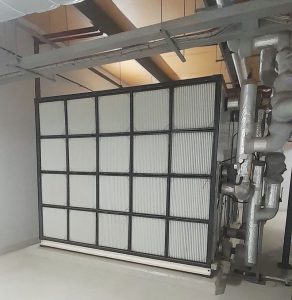
Chilled and hot water air handling unit. Primary fresh air filters and behind them are the secondary filters for the fresh air supply,
which is one of two fresh air supply systems
The role of the bms
The BMS functioned as the hospital’s operational command centre. It provided real-time monitoring of environmental conditions across the facility, allowing technicians to detect early signs of malfunction. The system also facilitated control and optimisation, enabling setpoint adjustments, energy-saving schedules and remote troubleshooting.
Beyond immediate monitoring, trend data collected by the BMS supported predictive maintenance. By analysing patterns such as rising motor amperage or declining airflow, technicians could anticipate mechanical wear or clogging and schedule interventions before failures occurred. This predictive capability was central to reducing unplanned downtime and maintaining reliability.
Working in a hospital environment demands instrumentation beyond the standard technician’s toolkit. Digital manometers were indispensable for measuring pressure differentials in critical rooms. Airflow capture hoods verified air change rates and diffuser performance. Thermal imaging cameras quickly identified electrical hotspots or coil blockages. Particle counters confirmed filtration effectiveness and cleanroom compliance, while refrigerant leak detectors and calibrated gauges supported environmental integrity and system performance.
All maintenance activities were captured within the CAFM system. Each record included asset identification, task details, technician notes, parts used and time taken. This created a complete, traceable history of every component. Historical data analysis informed future maintenance strategies – identifying recurring issues, refining service intervals and supporting capital planning.
For audits and accreditation, documentation was paramount. The hospital maintained a full asset register, electronic and physical logbooks in major plant rooms, and specific logs for filter changes and pressure verifications. Technician certifications, including Safe Handling of Refrigerants and infection control training, were recorded and readily accessible for inspection.

Chilled and hot water air handling unit – inside a recovery unit.
Team structure and training
I oversaw a multi-level maintenance team designed to balance expertise, responsiveness and skill development. As technical manager, I was responsible for overall strategy, compliance and planning. Senior technicians handled complex diagnostics and mentorship, while core technicians performed scheduled preventive work and first-response repairs. Junior technicians and apprentices gained experience under supervision, with measurable improvements in productivity and capability.
Essential qualifications included formal trade certification in Refrigeration and Air Conditioning, along with mandatory Safe Handling of Refrigerants accreditation. Additional hospital-specific training covered infection control procedures, gowning and clean-area protocols, and permit-to- work systems for high-risk maintenance activities. Proficiency in the hospital’s BMS and CAFM systems was required, along with manufacturer-specific training on equipment such as chillers and VRF systems.
Although patient safety remains the overriding objective, energy management plays an important role in hospital sustainability. The team’s integrated efficiency measures directly into its maintenance routines. Clean condenser and evaporator coils improved heat exchange efficiency, reducing compressor load. Regular filter replacement prevented excessive fan energy use.
Leaks – whether refrigerant or chilled water – were identified and repaired promptly, minimising losses and protecting equipment. The BMS was programmed to introduce temperature setbacks in non-critical zones during unoccupied hours, and chilled and hot water setpoints were continually reviewed to avoid unnecessary overcooling or overheating. Even a one- degree optimisation translated into tangible energy savings across the system.

Chilled and hot water air handling unit. Primary fresh air filters and behind them are the secondary filters for the fresh air supply,
which is two of two fresh air supply systems.
A digital transformation
The most significant innovation implemented was the complete digitisation of maintenance management. Transitioning from inherited paper-based records to a fully digital, data-driven system revolutionised operational transparency and reliability.
By integrating the asset database with the CAFM system, the hospital effectively created a digital twin of its HVAC and mechanical infrastructure. This provided complete visibility into every component’s service history, enabled automated preventive scheduling and allowed data-driven decision-making at management level.
The results were measurable. Unplanned downtime decreased by more than 25%, maintenance compliance improved and budget planning became evidence-based. Technicians operated with greater efficiency, guided by system-generated tasks and backed by accessible, detailed records.
This transformation epitomised a shift from reactive maintenance to intelligent asset management – aligning perfectly with the philosophy of ACCM Airconditioning, where expertise, transparency and comprehensive service delivery underpin every project.
Beyond the machinery lies a fundamental truth: in healthcare, air is part of the cure. The ability to maintain its purity, temperature and pressure is not just an engineering achievement – it is a vital safeguard for every patient who walks through the hospital door.