By Eamonn Ryan
Speaking at the Howden Technology Day, Matthew Slabbert, Applications engineer at James Howden Holdings, explored how mine cooling systems have evolved to meet these challenges. This is part two of a two-part series.
Cooling systems are significant energy consumers, and efficiency is critical. © RACA Journal
When mines push beyond depths of 6km, the rules of cooling change. Conventional systems become increasingly inefficient, and new approaches are required. According to Matthew Slabbert, this is where ice-based cooling systems offer a decisive advantage.
The effectiveness of ice lies in its ability to absorb heat during the phase change from solid to liquid. Slabbert highlighted the scale of this advantage: “One hundred kilograms of ice can provide about 39 megawatts of cooling.”
This is significantly higher than chilled water, and the implications are profound. “About 23kg of ice will give you the same cooling as 100kg/second of chilled water,” he explained. This dramatic reduction in required mass flow enables more efficient system design, particularly at extreme depths.
How ice cooling systems work
Despite their complexity, ice cooling systems follow a logical process. “Ice is produced on surface, transported down the shaft, stored underground in an ice dam, and then used to cool air through bulk air coolers,” Slabbert explained. The system operates in a continuous loop. “The hot water produced is pumped back to surface for pre-chilling and reprocessing through the ice plant,” he added.
A key distinction in ice cooling is the type of ice used. Slabbert clarified that, “Hard ice is made on the surface of a heat exchanger using mechanical refrigeration with ammonia.”
This results in a high-quality product. “It typically has an ice mass fraction of between 93% and 98%,” he said. By contrast, soft ice is produced differently. “Soft ice is made using the vacuum ice principle, where water can both boil and freeze at the same time under low pressure conditions,” he explained. However, performance differs significantly. “Soft ice has a lower ice mass fraction of around 60–70%, which means higher flow rates are required to achieve the same cooling,” Slabbert noted.
Case study: Deep-level innovation in SA
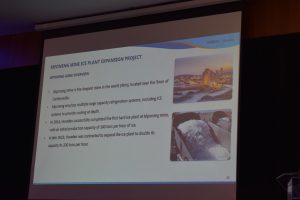
One of the most advanced applications of ice cooling can be found at Mponeng Mine near Carletonville. Slabbert described its scale and evolution: “The first phase of the hard ice plant had a production capacity of 100 tons per hour, and it was later expanded to 200 tons per hour.”
The system incorporates advanced engineering throughout. “The plant uses ammonia screw compressors, plate ice makers and enclosed conveyor systems to minimise heat losses,” he explained.
Transporting the ice efficiently was a critical challenge. “We use tube conveyors, which allow for enclosed transport, steeper angles and reduced spillage,” he said.
Efficiency gains at extreme depths
The deeper the mine, the more pronounced the benefits of ice. Slabbert illustrated this with a comparison: “To provide 10 megawatts of effective cooling underground, you might need about 20 megawatts installed using conventional chilled water, but only about 11 megawatts using a hard ice system.” This efficiency gap continues to widen as depth increases, making ice systems increasingly attractive.
Cooling systems are significant energy consumers and efficiency is critical. Slabbert explained the relative performance: “A surface bulk air cooling plant typically has a coefficient of performance of about five.”
By comparison, “An ice plant will sit with a coefficient of performance of around three.” While ice systems may appear less efficient at surface, their ability to deliver cooling effectively at depth often results in better overall system performance.
Mine cooling has evolved from simple beginnings to highly engineered systems. As Slabbert reflected, “As mines continue to go deeper, we have to continuously adapt our cooling methods.”
Ice-based systems are no longer experimental – they are becoming essential for the future of deep-level mining.
© RACA Journal