By Eamonn Ryan
Speaking at the Howden Technology Day, Matthew Slabbert, Applications engineer at James Howden Holdings, explored how mine cooling systems have evolved to meet these challenges. This is part one of a two-part series.
Deep-level mining presents one of the most demanding thermal environments in modern engineering. As operations extend further below surface, rising rock temperatures and increasing heat loads from equipment create conditions that are not only uncomfortable, but potentially unsafe.
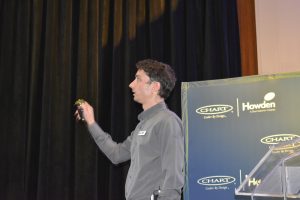
Matthew Slabbert, Applications engineer at James Howden Holdings. © RACA Journal
At its core, mine cooling is about creating a safe and workable underground environment. Without it, productivity declines and safety risks increase significantly. As Slabbert explained, “In mine cooling, we aim to reduce the high underground temperatures to create a safe and workable environment.”
Cooling systems are designed to deliver either cooled air, chilled water, or a combination of both, depending on the mine’s requirements. The selection of a cooling strategy is never straightforward. Slabbert noted that, “Key factors include mining depth, underground heat loads, distances, available space both on surface and underground, and the cost of power.”
Stage 1: Ventilation and surface bulk air cooling
Most mines begin their cooling journey with ventilation. Fresh air is circulated underground to remove heat and maintain breathable conditions. The simplest enhancement to this is surface bulk air cooling, where air is cooled on surface before being sent down the shaft. Slabbert described this as, “typically simpler and generally the least expensive option.”
However, its limitations quickly become apparent. “We can only cool that air to realistically around five degrees before sending it underground,” he explained, adding that performance is also constrained by airflow volumes and ambient surface temperatures.
As a result, this method is generally effective only to a certain depth. “That configuration on surface is typically only effective until about 2km below surface,” he said.
Stage 2: Chilled water systems
To extend cooling further underground, mines turn to chilled water systems. Water offers significant advantages in terms of heat absorption and transport. “Chilled water can be transported over much further distances with minimal thermal losses on route,” Slabbert noted.
In practical terms, the capacity is substantial. “A flow rate of around 100kg/second can absorb about nine megawatts of cooling,” he said. But these systems come with their own challenges. “The downside is that the cost of the reticulation system is quite high, and can often be higher than the rest of the cooling equipment,” he cautioned.
Because of these cost and efficiency constraints, chilled water systems are typically limited in depth. “To keep that economical, we generally limit it to about 2.5–3km below surface,” Slabbert explained.
Reaching the limits of conventional cooling
As mines extend deeper, conventional cooling methods begin to struggle. Heat loads increase, distances grow longer and energy requirements rise sharply. At this point, incremental improvements are no longer enough. As Slabbert put it, “As we get further and further down, we need to start to explore different methods of cooling.”
That turning point leads to the next stage in mine cooling evolution: ice-based systems.
© RACA Journal