By Eamonn Ryan
A practical look at how HVAC&R controls have evolved — from electromechanical systems to intelligent, integrated platforms shaping the future.
Ⓒ RACA Journal
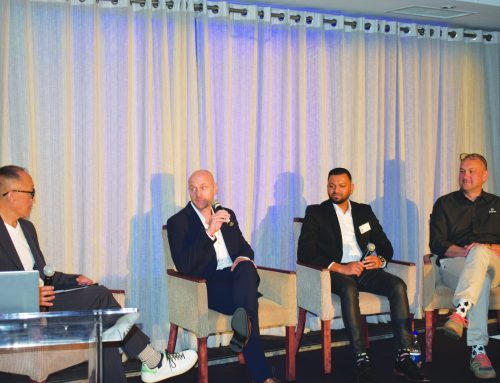
At the January 2026 Cape Town TechTalk, Ben Milne, Western Cape manager at Keystar Industries, delivered a practical presentation on PLC-based HVAC and refrigeration controls. Drawing on more than two decades of hands-on experience in refrigeration, HVAC controls, ammonia and CO₂ systems, fault finding and technician training, Milne set out to strip away much of the intimidation surrounding PLCs (Programmable Logic Controllers) and modern electronic controllers, replacing it with clear fundamentals and real-world context.
Rather than approaching the subject from an academic or theoretical angle, the talk focused on how controllers are actually used in the field, why they exist, where technicians commonly go wrong and how the industry is rapidly moving towards integrated and intelligent systems.
Milne began by grounding the discussion in a reality familiar to anyone who has worked on older installations. Traditional control systems built around electromechanical thermostats, timers, delay relays and selector switches were robust but bulky, labour-intensive and increasingly impractical. Attempting to replicate the functionality of a modern controller using discrete components quickly results in large panels filled with wiring, increased installation time and a far higher risk of wiring errors.
In environments such as supermarkets, where a single store can contain dozens of cabinets, evaporators and fans, this approach is no longer viable. Electronic controllers dramatically reduce panel size, simplify wiring, shorten commissioning time and allow for functions that mechanical systems simply cannot perform. Electronic expansion valves, variable-speed compressors and fan modulation are now standard expectations rather than specialist features.
The shift to controllers was therefore not driven by fashion or complexity, but by necessity. Efficiency targets, energy costs, space constraints and system complexity all demand a more compact and intelligent approach to control.
FROM MECHANICAL RESISTANCE TO ELECTRONIC ACCEPTANCE
Milne drew a parallel between the industry’s historical resistance to electronic controls and the hesitation many technicians now feel towards PLCs and advanced software-driven systems. Two decades ago, many contractors refused to work with electronic expansion valves, preferring the familiarity of mechanical alternatives. Today, electronic valves are commonplace, and technicians are expected to understand how to commission and fault-find them.
According to Milne, the industry is standing at a similar crossroads. PLCs, integrated monitoring and AI-driven analytics may seem intimidating, but they represent the next logical step in system evolution rather than a radical departure from established principles.
A key part of the presentation was clarifying the difference between standard electronic controllers and PLCs. Standard controllers are typically pre-programmed, certified and sold as finished products. Their development cost is spread across thousands of units, making them cost-effective and reliable for repeatable applications. These controllers arrive with known behaviour, manuals and defined operating parameters, which makes them ideal for the majority of HVAC and refrigeration applications.
PLCs, by contrast, are essentially blank devices supplied without application-specific software. Their strength lies in flexibility. They can be programmed to do almost anything, but that flexibility comes at a cost. Custom software must be written, tested, commissioned and maintained. If that knowledge is lost over time, the long-term risk to the end user can be significant.
Milne stressed that PLCs are not inherently bad or risky. The danger arises when custom programming is deployed without proper documentation, standardisation or long-term support. For this reason, Keystar actively promotes the use of standard, tried-and-tested solutions wherever possible.