By Eamonn Ryan
At the recent Howden Technology Day, Stephan Bergh, mining lead for Africa, Middle East and India at Howden, presented the case for the adoption of ventilation on demand (VOD) systems in underground mining. This is part two of a two-part series.
Through a network of sensors and communication systems, real-time data is fed into the software. © RACA Journal
Drawing on over a decade of hands-on experience as a ventilation engineer, Bergh outlined how intelligent ventilation solutions are transforming mine safety, energy efficiency and environmental performance.
Mine ventilation has always been central to underground safety, ensuring acceptable working conditions by controlling heat, dust and harmful gases. However, Bergh highlighted that traditional design approaches are often overly conservative. Safety margins are typically layered throughout the design process, resulting in systems that may be oversized by as much as 30–50%.
While this conservatism has historically been justified, it comes at a cost. Many mines operate large fans and cooling systems at full capacity around the clock, even though peak demand conditions occur only intermittently. In an era of rising energy costs and increasing environmental, social and governance (ESG) pressures, this ‘always-on’ approach is no longer sustainable.
The solution, Bergh argued, lies in shifting from static to dynamic ventilation systems – specifically, VOD.
What is ventilation on demand?
Bergh explains that VOD is not a single technology, but rather part of a broader intelligent ventilation strategy. At its core, VOD adjusts airflow in real time based on actual underground conditions, including equipment activity, personnel location and environmental measurements.
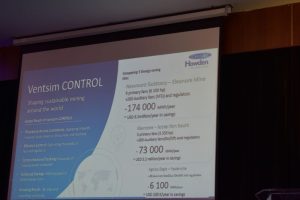
Howden’s proprietary Ventsim Control platform integrates modelling, monitoring and automation into a single system. Building on the capabilities of Ventsim Design software, it enables remote and autonomous control of ventilation infrastructure, including fans, regulators and dampers.
Through a network of sensors and communication systems, real-time data is fed into the software, which calculates the required airflow and automatically adjusts equipment to meet demand. This can include starting or stopping fans, varying fan speeds, or opening and closing regulators.
One of the key advantages of modern VOD systems is its flexibility. Mines do not need to adopt full automation immediately; instead, implementation can follow a phased approach:
- Manual remote control: Operators can control ventilation equipment remotely
- Automated scheduling: Ventilation is adjusted based on predefined shift patterns
- Sensor-based control: Real-time environmental data drives system responses
- Tracking integration: Airflow responds dynamically to the location of people and machinery
- Advanced optimisation: Algorithms continuously optimise system performance
This staged approach allows mines to build confidence and capability over time while delivering incremental benefits.
© RACA Journal