By Eamonn Ryan
Continuing a presentation from the recent Howden Technology Day, Stephan Bergh, Mining Lead for Africa, Middle East and India at Howden, reviewed the case for the adoption of ventilation on demand (VOD) systems in underground mining. This is part two of a two-part series.
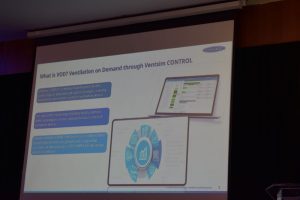
As mines face mounting pressure to improve efficiency, reduce emissions and enhance safety, intelligent ventilation systems are becoming increasingly essential. © RACA Journal
The most immediate and measurable benefit of VOD is energy reduction. Ventilation systems can account for 40–50% of a mine’s total energy consumption, making them a prime target for optimisation.
Bergh illustrated this with a case study where reducing fan speed by just 26% resulted in nearly 60% energy savings. This is due to the well-known cube relationship between fan speed and power consumption.
In practical terms, savings can be substantial. A Botswana operation achieved annual energy savings of 8 760MW/h, equivalent to powering up to 2 000 households. Carbon emissions were reduced by up to 11 000 tonnes per year – comparable to removing nearly 2 000 vehicles from the road.
Globally, Howden reports successful VOD implementation at more than 36 mine sites, with some operations achieving multi-million-dollar annual savings.
While energy savings are significant, Bergh emphasised that safety remains the primary driver behind VOD development.
Real-time monitoring enables proactive management of underground conditions, replacing the traditionally reactive approach. Instead of identifying overexposure to dust or heat days after the fact, operators can respond immediately to changing conditions.
Additional safety benefits include:
- Early warning systems with alarms and notifications
- Automated emergency response strategies, such as fire management
- Improved visibility of underground environmental conditions
Productivity gains are also notable. By optimising ventilation during blasting cycles, some mines have reduced re-entry times by several hours per day, increasing face time and output. Furthermore, dynamic ventilation allows for more flexible fleet deployment, as airflow can be adjusted to match equipment usage.
Supporting ESG objectives
With increasing pressure on mining companies to demonstrate environmental responsibility, VOD offers a clear pathway to reducing carbon footprints.
The inclusion of carbon tracking tools within systems like Ventsim Control enables mines to quantify emissions reductions alongside energy savings. This data can support ESG reporting and strengthen a mine’s social licence to operate.
Despite its benefits, VOD adoption – particularly in Africa – has been slower than expected. Bergh identified several key barriers:
- Communication infrastructure: Reliable underground networks (such as Wi-Fi, fibre or LTE) are essential.
- Sensor reliability: Equipment must be robust enough for harsh mining environments.
- Change management: Resistance to new technologies and processes can hinder implementation.
- Integration complexity: Systems must work seamlessly with existing mine infrastructure.
- Upfront cost and business case clarity: Detailed financial analysis is required to justify investment.
Importantly, Bergh noted that VOD is no longer a “proof of concept” or emerging technology. It is a proven solution with a track record spanning more than a decade.
A recurring theme in the presentation was the critical role of proper ventilation design. Attempting to optimise a poorly designed system is both difficult and costly. Whether for new developments or retrofits, a well-engineered ventilation network forms the foundation for successful VOD implementation.
A roadmap for the future
As mines face mounting pressure to improve efficiency, reduce emissions and enhance safety, intelligent ventilation systems are becoming increasingly essential.
Bergh concluded that the integration of people, processes and technology is key to unlocking the full potential of ventilation on demand. With the right design, infrastructure and strategy in place, VOD offers a powerful tool to transform underground mining operations – delivering safer working environments, lower costs and a more sustainable future.
© RACA Journal