By Eamonn Ryan
Fugitive carbon gas emissions in deep-level gold mines.

Alan Cook, consultant and director at Latona Consulting. All images by © RACA Journal
In a crucial presentation at the 2025 Mine Ventilation Society of South Africa (MVSSA) conference, Alan Cook, a seasoned consultant and director at Latona Consulting, unveiled findings from a baseline assessment of fugitive carbon gas emissions at a deep-level South African gold mine. His research not only quantifies the mine’s contribution to greenhouse gases but also provides vital comparisons with emissions from coal and platinum operations, underscoring the global imperative for accurate monitoring and reporting.
Alan Cook brings a wealth of experience to this critical topic, with a B.Sc. in mining from Strathclyde University, a Masters from the School of Mining at Wits, and a distinguished career spanning Gencor, CSIR, Sasol and Atasco Consulting Group. He has undertaken extensive work in methane and other flammable gases across coal, gold and platinum mining, coupled with involvement in explosion investigations and major research projects, positioning him to address the complexities of fugitive emissions.
Unearthing the invisible
Cook reported as follows:The primary objective of this baseline assessment was to quantify fugitive carbon gas emissions – specifically, gases emanating directly from the mine’s ventilation fans, distinct from emissions generated by electricity usage or surface diesel fleets.The goal was to establish a reliable baseline using direct sampling and gas analysis.This approach, while labour-intensive, provides precise data crucial for aligning with IPCC (Intergovernmental Panel on Climate Change) guidelines for greenhouse gas reporting and supporting sustainable mining practices. It also serves to inform ventilation management strategies, a topic of increasing relevance in the context of climate change.
The study focused on two main shafts, designated Shaft 1 and Shaft 2, each equipped with surface ventilation fans. Data collection involved a continuous 48-hour monitoring period at each shaft, conducted by three teams working eight-hour shifts. Physical gas samples were collected every 30 minutes, with increased frequency to 15-minute intervals post-blast to capture any significant effects from blasting fumes. This rigorous methodology yielded a substantial dataset of 127 samples per site, totaling 254 samples, providing a robust foundation for the baseline assessment. Background samples were also taken at the start and end of each shift, with the lowest background values used to calculate worst-case emissions. Sample analysis was performed at Pelindaba using GCMS (Gas Chromatography-Mass Spectrometry), capable of detecting concentrations down to 50ppm (parts per million). For methane (CH4), which is often registered below this threshold, selected samples were re-analysed using PDHID (Photoionisation Detector with Hydrogen Flame Ionisation Detection) to achieve detection limits as low as 2ppm. Samples were collected using hand pumps to fill 500-millilitre flexible bags, with each bag meticulously numbered and time- recorded. Barometric pressure was also recorded on the surface to account for its potential influence on gas concentrations.
Quantifying fugitive emissions
The results for Shaft 1 showed CO2 concentrations varying, with an average around 800ppm, peaking at approximately 1 300ppm. After subtracting background levels, the CO2 attributed to the mining operation was about 150ppm.
For Shaft 2, CO2 concentrations exhibited more variation, also averaging around 800ppm, with some peaks linked to blasting periods. The net CO2 from Shaft 2 was approximately 200ppm. These concentration values were then converted to total annual emissions by multiplying them by the ventilation quantities (cubic meters per second) flowing through each fan, assuming 360 working days per year, and converting gas volumes to mass. The IPCC’s figure for CH4 was used for methane calculations.
The total annual fugitive greenhouse gas emissions were calculated as follows:
Shaft 1:
CO2: Between 3 000 and 3 500 tons per year. CH4: Between 42 and 50 tons per year.
Shaft 2:
CO2: Between 11 800 and 13 200 tons per year. CH4: Between 76 and 92 tons per year.
Cook noted that these figures, particularly for CO2, often seem “low” when compared to global-scale emissions, which are typically discussed in millions of tons. However, when aggregated across all shafts and mines, they become more substantial. The ranges provided reflect statistical plus/minus deviations from the average, as advised by CSIR for South Africa’s national inventory.
Comparative analysis and reporting implications
To contextualise these findings, Cook compared them with data from other South African mines:
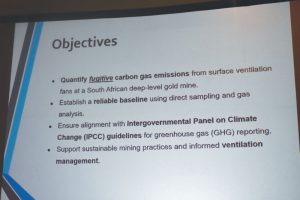
Part of the presentation
Platinum Mines (for example, Rustenburg Platinum, 2008 data): Individual shafts emitted between 150 and 23 000 tons of CO2 per year, and 5 to 145 tons of CH4 per year. The gold mine’s emissions, therefore, fall within a comparable range.
Underground Coal Mines (2005 & 2012 data): Individual shafts typically emit between 100 and 600 tons of CH4 per year (some significantly more), and 500 to 5 500 tons of CO2 per year. Total methane emissions for South African coal mines were estimated between 70 000 and 80 000 tons per year, a substantial reduction from previous international model estimates of up to 2 million tons per year, underscoring the value of direct measurement.
In terms of reporting, South Africa’s national reporting threshold for greenhouse gases is 10 000 tons per year. Based on the calculated emissions, Shaft 2’s CO2 equivalent (CO2e) emissions (which account for methane’s higher global warming potential – 25 times that of CO2, though recently updated to 27 – would exceed this threshold, requiring reporting. However, it was clarified that this threshold currently excludes fugitive emissions, meaning Shaft 2 would not be required to report these specific emissions under current regulations. Annual reporting is due by March each year, with a five-year data retention requirement.
Conclusions and future outlook
The study’s conclusions reinforce several critical points:
- The calculated baselines for the two shafts show significant, albeit lower than intuitively expected, CO2 and CH4
- While Shaft 2’s CO2e emissions exceed the 10 000-ton threshold, current regulations exclude fugitive emissions from this reporting requirement.
As emphasised by a representative from the Mine Health and Safety Council, compliance with the Paris Agreement and national goals necessitates reliable monitoring and reporting. It is crucial to distinguish between carbon sources and actual carbon emissions, and there are penalties for misleading reports. Audience questions further explored the methodology and implications. Regarding the sample bags, Cook clarified that they are evacuated by Nexa and typically inflated to about half capacity, with samples sent directly to labs due to potential deterioration over time. While the standard analysis includes 27 individual gases, the focus for this project was on CO2 and CH4 due to their significance.
The discussion also touched on the future impact of carbon credits. While the current CO2 tonnage from gold mines might seem low, the eventual calculation of carbon credits per ton could significantly impact mining models, making even these “low” emissions a financial consideration. The presentation highlighted that while gold mines may have lower CH4 emissions than coal mines, particularly Free State coal mines are known for significantly higher CH4 levels.
Ultimately, Alan Cook’s research provides a robust, data- driven baseline for understanding fugitive carbon gas emissions from deep-level gold mines. It underscores the importance of direct measurement over broad models, the need for accurate reporting, and the growing relevance of these emissions in the broader context of climate change and sustainable mining practices.