By Eamonn Ryan
At Solar & Storage Live Africa in Gauteng, the session ‘Unlocking the grid: solving SA’s interconnection bottlenecks’ turned into a candid fireside chat. Moderated by Maria Michael, managing director of Michael and Co Sustainable Power, together with Percy Koji, president and CEO: Hosana Green Energy, a Q&A segment turned the spotlight onto the next generation of entrepreneurs.
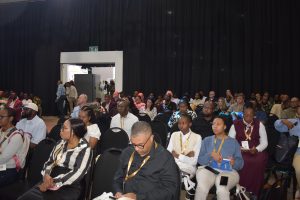
The audience.
© RACA Journal
On visitor from Foundation One described her business model: a zero‑capex solar solution that offers businesses:
- Free solar panels
- Free installation
- Free maintenance and insurance
She is looking to scale to larger sites (for example, 100 hectares) on traditional or CPA (communal) land. Her main challenge: banks often see these projects as “not bankable” due to perceived land‑tenure and political risks.
Koji’s advice focuses on relationships and legitimacy:
- Build strong relationships with local authorities:
- Municipal officials
- Traditional leadership
- Demonstrate that you are not just an outsider chasing a deal, but someone who cares for the community and is invested in its long-term development.
- Be patient with political and administrative processes; support often follows once trust is established.
Entering new markets like EVs and emerging clean-tech
Another audience member asked how to approach new markets such as electric vehicles (EVs) and related clean technologies, given the complex energy legislation and regulation [0:22:59–0:23:50].
Koji’s response, while general, outlines a practical roadmap:
- Do deep research on the industry before committing capital.
- Find experienced partners already active in the space who can:
- Explain regulatory requirements.
- Share lessons learned.
- Co‑develop business models.
- Leverage your experience from other ventures (even outside energy) as:
- Proof of execution capability.
- A foundation for learning how to manage risk and relationships in a new sector.
Work across divides – People, languages and backgrounds
Koji closes with a broader piece of guidance for South African entrepreneurs:
- Don’t restrict yourself to working only with people who look like you or share your language.
- “Work with people from all walks of life” – every South African, he argues, has something to contribute.
- Many people inside municipalities and institutions do want to help, even if the broader system has a negative reputation.
This advice dovetails with the session’s overarching theme at Solar & Storage Live Africa: solving grid and interconnection bottlenecks requires not only technical and financial expertise, but coalitions of people – from villagers and kings to councillors, engineers and financiers – who are willing to build something credible together.