By Eamonn Ryan
In an industrial park in Johannesburg South, the hum of newly installed machinery signals more than routine production.

Fan Movement owner and mechanical engineer Zinziso Xhallie. © RACA Journal
It marks a decisive shift for Fan Movement (Pty) Ltd – from distributor to manufacturer – and a bold statement about the future of local engineering capability in South Africa. Founded in 2015 by mechanical engineer Zinziso Xhallie, Fan Movement has grown from a specialist distributor of Howden industrial ventilation equipment into an emerging local manufacturer of high-performance air-movement solutions. Born in Cradock in the Eastern Cape, Xhallie built the business on nearly two decades of experience spanning engineering, sales, distribution and manufacturing operations. Today, his focus is to scale up local production, deepen technical capability and position the company as a credible African supplier in a competitive global market.
Prior to founding Fan Movement, he served as a sales agent for Howden (Howden Donkin division), where he successfully expanded market penetration. Following the closure of the Howden Donkin division in 2021, Xhallie executed a strategic acquisition of distribution inventory, enabling continuity of supply and immediate revenue generation while strengthening customer retention. “Fan Movement established its facilities in 2021, during which time we operated solely as a distributor of products. Our transition into manufacturing started in 2024, and since then we are actively implementing systems to strengthen our quality control processes,” Xhallie explains. That transition has been strategic rather than abrupt. For several years, Fan Movement operated through strong relationships with leading international suppliers, ensuring access to globally benchmarked products and technologies.
“We are differentiated by our strong relationships with leading international suppliers, which enable us to remain aligned with global trends and technological advancements. This strategic support allows us to deliver cutting- edge solutions both locally and across the African continent,” says Xhallie.
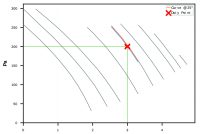
odel Number: MAXFLO/630/250/7/1440/25 – performance curve @ 1.2Kg/M³. Supplied by Fan Movement
The company continues to operate on what Xhallie calls a hybrid model – combining international sourcing with growing local manufacturing capability. However, bringing cased axial flow fan production in-house in 2024 marked a significant operational milestone. The move reduced dependence on external lead times, strengthened supply chain resilience, and shortened turnaround times for customers in mining, heavy industry and the built environment.
The impact is measurable. Previously outsourced, components such as fan casings are now manufactured internally. As a result, approximately 60% of component value in certain product lines is locally produced. This shift not only reduces costs but also improves production control and flexibility. Fan Movement’s shop floor reflects a company in technical transition. Alongside fabrication equipment, an upgraded testing bay now measures real-time amp draw during fan performance tests – part of a broader focus on energy efficiency and compliance with South Africa’s recently introduced Minimum Energy Performance Standards (MEPS).
“All our AC motors used are IE3. Since we have been in business, all our imported fans with AC electric motors were already IE3, which has been a standard internationally,” Xhallie notes. The shift from IE1 to IE3 motors represents a substantial jump in energy performance. In HVAC applications – where motors traditionally used foot-mounted configurations – the transition has required adjustments in mounting systems and sourcing. Fan Movement is also planning comparative testing between IE1 and IE3 motors to demonstrate real-time power consumption differences – data that consulting engineers increasingly demand. In addition, the company imports EC fans equipped with IE5-level motor efficiency, ensuring alignment with global trends as the local market anticipates possible future shifts toward IE4 and IE5 standards.
Quality assurance is another pillar of the local manufacturing drive. “We have developed internal quality control systems to check every fan that we manufacture,” he confirms. The company’s test
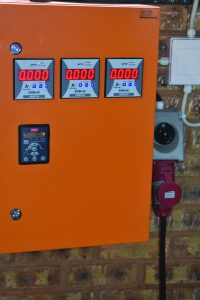
The testing machine. © RACA Journal
bay records amperage, speed and other performance indicators, and Fan Movement is upgrading its variable speed drive (VSD) testing systems to provide more detailed performance data. Consulting engineers, he explains, typically require performance curves, absorbed power data, and efficiency figures to verify that a selected fan will meet specified air volume and pressure requirements. To support this, the company is finalising its own fan selection software – designed to generate detailed performance data, including motor size, frequency and mechanical efficiency.

Fan Movement workstation in the factory. © RACA Journal
Third-party certification is also under consideration, particularly for new product ranges. While acknowledging that accredited laboratory testing is costly, Xhallie recognises its importance for market credibility. Geographically, Fan Movement’s ambitions extend beyond South Africa. Drawing on Xhallie’s previous experience in African markets, the company already supplies projects in both southern and northern Africa. The long-term goal is to strengthen its identity as an African-based industrial engineering supplier – one capable of competing on performance, efficiency and lead time. For now, the emphasis remains disciplined growth. “We recognise the increasing demand for technological advancement in the fan industry, and we are committed to investing in R&D capability,” he says.
In a sector often dominated by imports, Fan Movement’s trajectory reflects a broader industrial narrative: rebuilding local capability, investing in compliance and efficiency, and steadily increasing the percentage of value created on home soil. For Xhallie, the strategy is pragmatic rather than ideological – manufacture what makes sense locally, source strategically where required and always measure performance. The planned expansion of floor space, machinery and in- house capability suggests that Fan Movement’s infancy stage may not last long.
“The company is finalising its own fan selection software – designed to generate detailed performance data.”