
By Eamonn Ryan
This article is based on a SAIRAC Cape Town TechTalk presented in May 2026 by Ralph Raad, a mechanical engineer, director at CFW and application engineer for fans and dehumidifiers of CFW. The presentation explored the engineering principles underpinning dehumidification system design and highlighted the critical role of humidity control in HVAC, industrial and process applications.

All images supplied by CFW Fans
Dehumidification is often treated as a secondary function of HVAC systems, yet in many industrial, commercial and process applications it is a primary design requirement. Inadequate humidity control can contribute to product spoilage, corrosion, microbial growth, condensation hazards, excessive frosting in refrigeration systems and reduced energy efficiency.
Understanding the underlying principles of dehumidification is therefore essential for engineers responsible for environmental control and process reliability.
MOIST AIR FUNDAMENTALS
Effective dehumidification design begins with an understanding of moist air properties. Relative humidity (RH) is commonly specified, but it is a temperature-dependent value and does not directly indicate the amount of moisture in the air.
Note: This article reflects a technical presentation and focuses on the fundamental concepts of dehumidification. For clarity, certain engineering principles have been simplified or generalised. Actual system performance and design considerations depend on the specific application, equipment, operating conditions and control strategies, and should be evaluated on a project-by-project basis.
For example, heating air without adding or removing moisture reduces its relative humidity because warmer air has a higher moisture carrying capacity. Conversely, cooling air increases its RH until saturation is reached. This illustrates why temperature and humidity should not be considered independently.
All images supplied by CFW Fans.
PSYCHROMETRIC PROCESSES
The psychrometric chart remains one of the most valuable tools for understanding air-conditioning and dehumidification processes. It graphically represents the relationship between temperature, moisture content, relative humidity, enthalpy and other air properties.
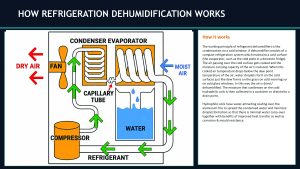
In refrigeration-based systems, air is cooled below its dew point so that moisture condenses on the cooling coil. The condenser then commonly reheats the dried air before it is supplied back to the conditioned space.
Desiccant systems remove moisture differently by adsorbing water vapour directly onto a hygroscopic material. The desiccant is subsequently regenerated using heat so that the cycle can continue.
The need for dehumidification extends well beyond occupant comfort. Excess humidity can affect health, product quality, structural integrity, safety and energy performance. Depending on the application, it may promote microbial growth, damage packaging, accelerate corrosion, create condensation hazards or reduce refrigeration efficiency through excessive frost formation.
Consequently, humidity control is frequently a critical process requirement rather than simply a comfort consideration.
AIR CONDITIONERS VERSUS DEDICATED DEHUMIDIFIERS
Although conventional air-conditioning systems remove moisture as part of the cooling process, their primary objective is usually temperature control. Moisture removal generally occurs only while sufficient cooling demand exists to maintain coil temperatures below the air’s dew point.
When sensible cooling loads are low, such as during cooler weather or at night, an air-conditioning system may cycle off before significant moisture removal occurs. Humidity levels can therefore rise even while temperature remains acceptable.
Dedicated refrigeration dehumidifiers operate differently. Their primary objective is moisture removal rather than cooling. Air is first cooled below its dew point to condense moisture and is then reheated by the condenser before being discharged back into the space. The result is drier air with a slightly elevated dry-bulb temperature.
Modern VRF and other advanced HVAC systems may incorporate humidity-control strategies and reheat functions, although these typically involve additional complexity and operate within defined design limits. In many applications, a dedicated dehumidifier integrated with a separate temperature-control system offers a more predictable humidity-control solution.
DEHUMIDIFICATION TECHNOLOGIES
The two principal dehumidification technologies are refrigeration-based systems and desiccant systems. Refrigeration systems include direct expansion (DX) dehumidifiers, chilled-water systems, glycol-cooled coils and VRF/VRV installations. All rely on cooling air below its dew point to remove moisture. These systems are widely used across comfort cooling and many commercial and industrial applications.
However, as coil temperatures approach freezing, ice formation becomes a significant challenge. Frost accumulation reduces heat-transfer performance and requires periodic defrost cycles, limiting efficiency in low-temperature applications.
Desiccant dehumidifiers are generally less constrained by freezing conditions and are capable of achieving significantly lower humidity levels than refrigeration systems in many applications.
Regeneration energy can be supplied by electricity, gas, steam, hot water or recovered process heat. The most suitable option depends on utility availability, energy costs and project requirements.
An important design consideration is that dehumidifier capacity varies significantly with inlet conditions. Refrigeration units are typically rated under warm, humid conditions where moisture removal is highest. The same unit may remove only a fraction of its rated capacity when operating at lower temperatures and humidity levels. Engineers should therefore evaluate actual operating conditions and consult manufacturer performance data rather than relying solely on nominal ratings.
Similarly, desiccant performance depends on inlet air conditions, regeneration temperature, rotor design and heat-recovery arrangements. Proper system selection requires consideration of the complete operating envelope rather than nominal capacities alone.
ENERGY PERFORMANCE
Specific energy consumption (SEC), expressed as kilowatt-hours per kilogram of water removed, provides a useful basis for comparing technologies. Refrigeration dehumidifiers generally achieve their best efficiency under warm, humid conditions. As operating temperatures decrease, frosting and defrost cycles can reduce efficiency.
Desiccant systems may require more regeneration energy when electrically heated. However, where waste heat or other low-cost thermal energy sources are available, they can become highly competitive, particularly in low-temperature or extremely low humidity applications.
Consequently, neither technology is universally superior; the preferred solution depends on the operating conditions and project objectives.
APPLICATION-BASED SELECTION
A practical comparison of alternative technologies demonstrated that life-cycle cost, rather than capital cost alone, should guide equipment selection. Depending on the operating conditions, refrigeration systems with heat recovery or desiccant systems may each offer the optimum solution.
Successful dehumidification design requires more than selecting equipment from a catalogue. Engineers must understand psychrometric principles, moisture loads, operating conditions and energy performance across the full range of expected environmental conditions.
Refrigeration dehumidification generally offers the greatest energy efficiency in warm, humid environments, while desiccant technology is often preferred where low temperatures or very low humidity levels are required.
By approaching humidity control as a primary engineering requirement rather than an auxiliary HVAC function, designers can improve product quality, reduce operational risks, enhance energy performance and deliver more reliable environmental control systems.


