By Eamonn Ryan
Sikla brings engineered modular support systems to the fast-growing data centre market (Part 1).
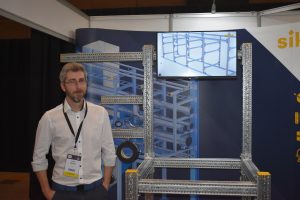
Sikla’s modular system is based on a simple one-screw technology assembled using torque wrenches.
© RACA Journal
As data centres continue to proliferate across Africa, much of the industry’s attention remains focused on cooling technologies, power systems and the growing demands of artificial intelligence workloads. Yet behind every chilled water line, chiller installation and HVAC system lies another critical component that seldom receives the same attention – the engineered infrastructure that supports and secures these services.
From carrying large-diameter chilled water pipework to enabling fast-track prefabrication of mechanical installations, modular support systems are increasingly becoming an important consideration in delivering reliable, scalable and maintainable cooling infrastructure. At the recent Pan African Data Centre Conference and Exhibition, Anton Swanepoel, managing member of Sikla South Africa, spoke about the company’s growing role in supporting the mechanical and electrical backbone of modern data centres and why properly engineered support systems are becoming an integral part of mission-critical HVAC installations.
When discussing data centres, conversations invariably gravitate towards power, cooling, connectivity and the latest advances in server technology. Yet beneath the floors, above the ceilings and throughout the plantrooms lies an equally important element that seldom receives the same attention – the infrastructure that physically supports these mission-critical systems.
Without properly engineered support structures, even the most sophisticated cooling or electrical systems cannot perform as intended.
It is within this often-overlooked space that Sikla has built its reputation internationally. Speaking at the Pan African Data Centre Conference and Exhibition, Swanepoel explained how the company’s modular support systems are helping data centre developers achieve three of the industry’s most important objectives: speed, reliability and scalability.
Rather than manufacturing the cooling systems, cables or pipework themselves, the company specialises in the engineered modular support systems that carry them safely and efficiently throughout a facility.
Originally established as a provider of support solutions for industrial pipework and plumbing applications, Sikla has evolved into a specialist in heavy mechanical and electrical installations. Today, its solutions are widely used across industrial projects and data centres internationally, particularly throughout Europe.
Importantly, Sikla does not operate in the primary structural space. Its expertise lies in what Swanepoel describes as the secondary steel environment – the supporting infrastructure that attaches to the building’s primary structure and carries the loads associated with mechanical and electrical services.
Whether supporting chilled water pipework, low- and high-voltage cable management systems, fire suppression infrastructure or gas piping, the principle remains the same: every installation should be properly calculated, engineered and certified. As data centres become larger and more complex, that level of engineering is becoming increasingly important.
One of Sikla’s key differentiators is its integration with Building Information Modelling (BIM) platforms. Rather than support systems being considered only once construction begins, they are designed into projects from the earliest planning stages.
The company’s plugins for leading design platforms such as AutoCAD Plant 3D and Revit allow engineers to select Sikla components directly within the BIM environment. Supports can be positioned within the digital model during design co-ordination, while cutting lengths, locations and configurations are determined long before materials arrive on site.
This early-stage integration offers several advantages. Potential clashes between services can be identified before construction commences, installation programmes can be accelerated and repeated assemblies can be prefabricated off-site. In data centres, where layouts often consist of highly repetitive installations, the benefits of prefabrication can be substantial.
Time, after all, is one of the industry’s most valuable commodities. Data centre developments are highly time-sensitive projects, with delays frequently carrying significant financial consequences. Although modular support systems may represent a higher upfront material cost than conventional approaches, Swanepoel argues that this should be viewed within the context of total project costs rather than individual line items.
Facilities can be handed over significantly earlier, labour requirements on site are reduced, and the need for hot works such as welding is virtually eliminated, improving both safety and compliance.
Sikla’s modular system is based on a simple one-screw technology assembled using torque wrenches, making installation straightforward for local contractors. Components can easily be loosened, repositioned or expanded should project requirements evolve over time, providing valuable flexibility as facilities scale to accommodate future customer demands.
For operators seeking to bring additional white space online quickly, that adaptability has become increasingly valuable.
While speed and scalability are critical considerations, data centres remain fundamentally mechanical and electrical environments. In part two, we will look at how Sikla’s engineered support systems are helping to deliver safer and more reliable cooling infrastructure – from chilled water pipework and chillers to plantroom installations – while addressing one of the industry’s most overlooked challenges: who is ultimately responsible for engineering the systems that support the services themselves?