By Eamonn Ryan
The air-conditioning units are not misplaced. They have been strategically distanced.
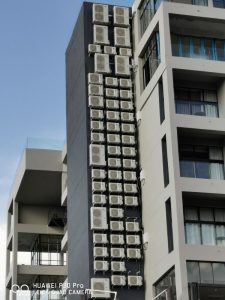
Supplied by a RACA Journal reader
At Emerald Crest Residences, Ikoyi, the apartments stand tall and elegant, all glass and promise. Several buildings away, on a lonely wall that appears to have been punished, dozens of outdoor AC units are stacked together like disciplined schoolchildren awaiting inspection.
Between them lies copper. So much copper.
This was not an accident. This was decided in a meeting.
Engr. Tunde Adeyemi arrived with drawings rolled under his arm and fear rolled into his posture. He had done the calculations. He had circled the pipe lengths in red. He had written NOT RECOMMENDED in bold.
Madam Olufunke Adebayo, Chairperson and Self-Appointed Guardian of Beauty, adjusted her gele. “Engineer,” she said, “these boxes. We don’t want to see them.”
“Yes, ma,” Tunde replied. “That is understood. But if we place them too far…”
“Too far is relative,” she said briskly. “Beauty is absolute.”
Mr Kunle Okonkwo, Treasurer and Amateur Economist, leaned forward. “When someone is buying a NGN(₦)180-million apartment,” he said, “and they open their balcony, what do they want to see?”
“The lagoon?” Tunde offered.
“Correct. Not equipment.”
Tunde swallowed.
“But sir, the longer the pipe run, the harder the compressor must work. Efficiency will drop dramatically.”
Madam Adebayo frowned. “So it will work harder?”
“Yes.”
She nodded, satisfied. “Good. We are not buying lazy machines.”
Tunde pointed weakly at his drawing. “If we place the units closer, behind louvres…”
“No,” said Mrs Balogun, head of Aesthetics and Final Authority. “People might suspect there is something behind the louvres.”
“What if we create a service balcony?” Tunde tried again.
“And lose sellable space?” Mr Okonkwo gasped. “Engineer, are you alright?”
“I am just saying that electricity consumption…”
Madam Adebayo waved him off. “Electricity is a personal lifestyle choice.”
The decision was unanimous.
Thus, all condensers were banished to the far wall. Pipework stretched across the building like a metal spider had crawled through accounting. Each apartment now enjoys a private, exclusive relationship with approximately 40m of copper pipe. At peak load, the wall radiates heat with the confidence of a generator farm. Units inhale each other’s exhaust. Thermodynamics weeps quietly.
But the façade? Flawless.
The apartments sold out almost immediately. “Buyers love the clean look,” Mr Okonkwo announced at the launch. “Very European.”
One buyer asked where the outdoor unit was. Madam Adebayo smiled serenely: “Far away.”
“How far?”
“Far enough.”
Brochures spoke proudly of uninterrupted elegance and thoughtful mechanical planning. Nobody asked what that meant.
Three months after occupation, electricity bills arrived. Residents gathered, confused, frightened, clutching statements that suggested they were cooling entire neighbourhoods.
“My AC runs for one hour and my meter faints,” complained one occupant.
A meeting was called. Engr. Tunde, thinner now, was invited.
“Engineer,” Madam Adebayo said gently, “people are saying the air-conditioning uses too much power.”
“Yes, ma,” he said. “Because the condensers are very far.”
She blinked. “But that was your design.”
“No, ma. That was your instruction.”
Silence. Then Mr Okonkwo nodded wisely.
“Okay. So the problem is NEPA.” (NEPA is Nigeria’s Eskom). Everyone agreed.
Today, Emerald Crest stands as a triumph of priorities. The Body Corporate earns praise. The building photographs beautifully. The AC wall hums bravely, heroically, pointlessly.
The occupants pay astronomical electricity bills and learn valuable lessons about aesthetics.
And somewhere in Lagos, in a well-ventilated boardroom, another engineer is opening his drawings while a chairperson leans forward and asks:
“Engineer… is it possible to hide them completely?”