By Eamonn Ryan: from Solar & Storage Live Africa 2026, Gauteng
The following discussion is drawn from a panel at Solar & Storage Live Africa, held in Gauteng in March 2026, where leading voices in the energy sector gathered to explore a central question facing South Africa’s transition: how to scale solar in a way that is not only fast, but financially credible, grid-compatible and capable of supporting long-term economic growth.
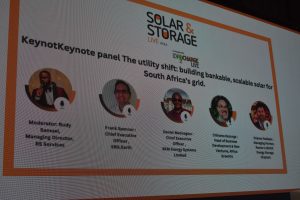
Several panellists warned that without a rapid acceleration in grid investment, viable projects could stall. © RACA Journal
Under the theme ‘The Utility Shift: Building Bankable, Scalable Solar for South Africa’s Grid’, the panel brought together a cross-section of developers, traders, engineers and energy strategists. Moderated by Rudy Samuel of RS Services, the discussion featured Frank Spencer (SBG Earth), Daniel Maduagwa (3KM Energy Systems), Etienne Rubbers (Renew), and Chikoma Kazunga (Africa GreenCo).
This is part one of a three-part series.
Very quickly, the conversation moved beyond the question of whether solar works. That debate, the panel agreed, is already settled. The real issue now is whether the system around solar is evolving quickly enough to support it at scale.
As one thread of discussion made clear, there is a tendency in the industry to focus almost exclusively on megawatts – how much capacity is being built, how fast it is being added, and where it sits on the grid. But several panellists cautioned that this view risks missing a deeper reality. A growing proportion of solar deployment across Africa is not actually grid-connected at all. Instead, it is happening behind the meter, in embedded systems and off-grid solutions that rarely feature in headline capacity figures, yet play a crucial role in expanding real energy access.
This shift in perspective led naturally into a broader point: scalability is no longer just about generation. It is about whether market structures are capable of absorbing, distributing and valuing energy where and when it is needed.
Nowhere is that tension more visible than in South Africa’s grid constraints. With an estimated 19 gigawatts of solar and wind projects in the pipeline over the coming years, concerns are growing that transmission infrastructure may become the limiting factor in the country’s energy expansion. Several panellists warned that without a rapid acceleration in grid investment, viable projects could stall not because of financing or technology, but simply because there is nowhere left to connect them.
At the same time, attention is increasingly turning to distribution-level opportunities, particularly within municipalities. Smaller utility-scale projects could play a significant role in decentralising supply, but doing so would require meaningful regulatory change and a shift in how municipal networks are governed and enabled.