By Eamonn Ryan
The scale of African data centre developments is changing rapidly.
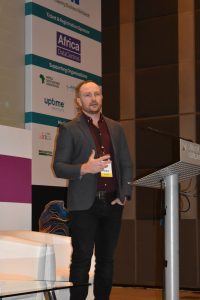
Moderator Marlo Walters, technical director and data centre lead at WSP.
© RACA Journal
What was once considered an exceptionally large facility only a few years ago is increasingly becoming part of mainstream planning discussions, with 100MW-class data centres expected to feature more prominently across key African markets in the coming decade.
This was one of the key themes explored during a panel discussion at the Pan Africa Data Centre Conference & Exhibition titled ‘Why power infrastructure is a driving force for site selection across Africa’.
Moderated by Marlo Walters, technical director and data centre lead at WSP, the discussion brought together Marc Matthews, director of engineering at Open Access Data Centres (OADC), Julia Power, partner in commercial property at Bowmans, Thulani Ncube, an independent energy strategy consultant, and Heath Andersen of DC Design Africa.
This growth presents enormous opportunities for the continent’s digital economy, but it also raises a fundamental question: can existing power infrastructure keep pace?
For smaller developments, engagement with local electricity distributors is often sufficient. Discussions typically involve municipal utilities or city power departments responsible for providing distribution-level connections.
However, as facilities move towards 100MW and beyond, the conversation changes dramatically.
Independent energy strategy consultant Thulani Ncube explained that developments of this scale force operators into an entirely different part of the electricity value chain. Instead of engaging exclusively with local distributors, developers must work directly with transmission system operators, national regulators and, in many cases, generation planners.
In South Africa, for example, this means conversations extend beyond municipal utilities to include organisations such as Eskom and the National Energy Regulator of South Africa (NERSA). Across other African markets, it similarly requires engagement with national transmission utilities, independent system operators where they exist, together with ministries responsible for energy policy and regulation.
The reason is simple: facilities consuming 100MW of power can no longer be treated as conventional commercial developments. They become strategic infrastructure projects with implications for national electricity networks.
This introduces what Ncube described as one of the sector’s most significant challenges – a mismatch between data centre development timelines and utility infrastructure planning cycles.
Data centre developers are accustomed to rapid delivery schedules. Customers frequently expect operational capacity within 18-24 months of making investment decisions, placing considerable pressure on developers to bring facilities online quickly.
Utilities operate on an entirely different timeline. Planning, designing and constructing new transmission infrastructure routinely takes three to four years or longer. Lead times for critical electrical equipment have also increased significantly, with some components now subject to global supply constraints extending between three and five years.
The result is a structural tension between private sector expectations and public infrastructure realities. If a 100MW data centre is expected to become operational within two years, conversations surrounding the transmission infrastructure required to support it may, in reality, have needed to begin three years earlier. By the time customers commit to occupying capacity, utility planning cycles may already be struggling to keep pace.
In response to these challenges, a growing number of developers are embracing self-build models. Power described how data centre operators are increasingly financing and constructing grid-adjacent infrastructure themselves. Depending on project requirements, this may include substations, transmission or sub-transmission lines, and even major upgrades to existing distribution networks.
Various commercial models are emerging to facilitate these arrangements. Some agreements provide for privately funded infrastructure to be transferred to utilities at a later date, occasionally accompanied by partial rebates or cost recovery mechanisms. Others establish long-term rights and responsibilities allowing operators to retain ownership or management obligations over privately funded assets.
Despite their growing popularity, self-build arrangements remain far from standardised. The legal and commercial frameworks governing such projects frequently differ between jurisdictions and, in many instances, are negotiated individually for each development. As Ncube observed during the discussion, determining what constitutes an appropriate agreement can sometimes resemble answering the question: “How long is a piece of string?”
This lack of standardisation inevitably introduces additional risk and complexity into projects that are already technically demanding.
Yet the trend reflects a broader reality shaping infrastructure development across Africa. Where public sector investment cannot always align with private sector timelines, developers are increasingly stepping in to bridge the gap. Private capital is becoming an important catalyst for accelerating the delivery of grid infrastructure that benefits both individual projects and, potentially, wider electricity networks.
As African data centres continue their journey towards hyperscale deployments, strengthening the grid will require more than simply increasing generation capacity. It will demand new forms of collaboration between governments, utilities and private investors willing to help build the infrastructure that tomorrow’s digital economy will depend upon.
With all of these complexities – demand, connectivity, land, grid, renewables and self‑build – many new entrants still repeat the same mistakes. Article 6 closes the series by looking at what new developers often get wrong, and what the panel sees as critical success factors for powering data centres in Africa