By Eamonn Ryan
When Prospero Muheki received the Schneider Electric Automation Student Award at the University of the Witwatersrand, it marked more than an academic milestone – it was a celebration of curiosity, resilience and purpose.

In Muheki, the future of African engineering looks bright. Supplied by Prospero Muheki
Sponsored by Schneider Electric for the eighth year, the award recognises top performance in Measurement and Control, honouring engineering excellence that advances Africa’s automation future.
Muheki, originally from Uganda, recalls how his fascination with “how things work and why” began as a child near a construction site. “Everyone waited for the engineer to arrive – that’s when I realised that engineers are the true engines of change,” he says.
Today, his ambitions are bold yet grounded. Over the next decade, he hopes to complete his MSc and PhD while becoming a lead engineer who mentors others. “As a black African, I didn’t have many people to look up to in engineering. I want to change that by showing what’s possible.”
His academic interests span electrical engineering, measurement and automation, but his curiosity reaches beyond. A stint with Paramount Aerospace Systems gave him hands-on exposure to aircraft systems and the interdisciplinary nature of engineering. “It showed me how different systems integrate – from control and power to structure – and how everything connects,” he says.
Faith and gratitude have also shaped his path. “God’s grace and donor support made it possible for me to study. Engineering, to me, is both a calling and a way to give back – to make the world more comfortable and sustainable.”
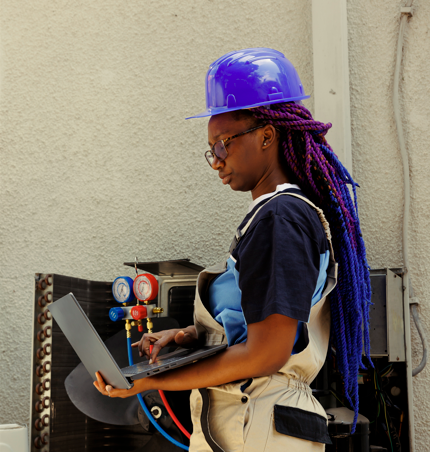
In discussing automation’s role in HVAC&R, Muheki’s insights reflect both technical understanding and social awareness. “Automation is critical because it helps manage energy, comfort and efficiency. HVAC&R systems can use 40–60% of a building’s energy, so optimisation makes a big difference,” he explains. “Smart controls, sensors, and predictive maintenance reduce waste and costs, while data insights help managers make smarter sustainability decisions.”
He believes engineers are at the heart of this transformation. “Our role is to design intelligent systems that integrate automation, data and renewable energy: systems that can predict and adapt in real time.”
In markets like South Africa, automation also promises accessibility and affordability. “By reducing energy costs and integrating solar or backup power, automation makes HVAC&R more reliable during load-shedding,” he says. “As costs fall and skills grow, this will make sustainable comfort available to more communities.”
Looking ahead, Muheki is most excited about predictive automation: systems that anticipate change instead of reacting to it. “Imagine buildings that pre-cool before a heatwave or adjust to save energy during high-tariff periods. That’s the kind of intelligence that can transform energy use in Africa.”
With his upcoming training at Schneider Electric’s academy in Midrand, Muheki is eager to continue learning, and leading. “I want to use automation, AI and creativity to bridge the gap between technology and everyday life,” he says.
In Muheki, the future of African engineering looks bright – driven by curiosity, grounded in purpose and powered by innovation.