35% reduction in fuel use and associated CO2 emissions, improved availability and reduced steam costs. This is part one of a two-part series.
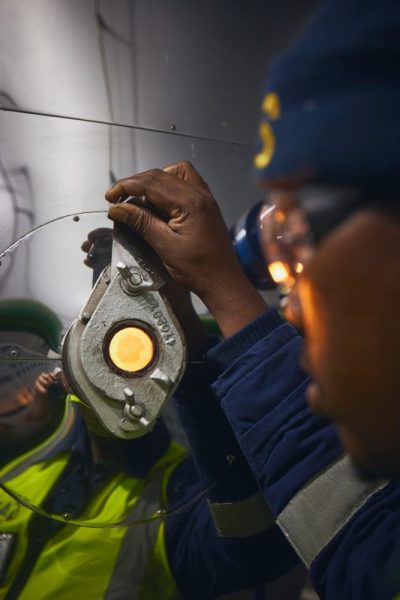
Boiler combustion checks. Supplied by AES
On-site energy utilities such as boilers must be independently managed to achieve meaningful performance outcomes. Steam and boiler operations and maintenance expert service provider, Associated Energy Services (AES), frequently discovers that companies incorrectly rely on a single fuel-to-product usage ratio to capture energy metrics and performance.
“This has significant implications as cost pressures, competitive forces and other challenges have decimated South Africa’s manufacturing sector in recent years. Consequently, these aspects must be independently managed to give the site the best possible chance of maintaining competitiveness while maximising profit margins” advises AES commercial director Dennis Williams.
One size does not fit all
Williams emphasises that thermal energy operations and utilisation in production facilities contain two major processes: the conversion / generation process and the production / utilisation process.
Multiple measurements are essential, including water meters to assess feed water to boilers and makeup water, temperature probes to measure condensate and feed water temperature; and also specialised probes to measure the CO2/O2 in flue gas. It is also important to monitor steam splits and condensate return volumes.
“At the outset, AES conducts an energy analysis as part of an initial proposal and solution development, identifying the current baseline and comparing it: either to client outcome expectations or AES’s best-case performance baseline.
Then, a more detailed energy analysis follows once AES is on site managing the client’s boiler operations and proactively addressing cost, efficiency, emissions performance, reliability and uptime,” Williams advises.
As energy management requires consistent effort and intervention, AES’s excellent experience, expertise, systems and methodologies are constantly applied, via a system of meticulous and ongoing checks.
“This intense level of energy management is beyond the scope and capability of clients and is furthermore frequently seen as a non-core business activity – which is where AES comes in and ‘fits’ perfectly,” he comments.
The perfect people
To this end, AES has a core national and regional team of experts to support client operations. Those on site are the critical client interface and ‘hands’ of AES.
While automation can successfully manage the combustion process on liquid or gaseous fuels, this does not apply to solid fuel combustion systems due to the variability of the quality of the fuel (particle size, moisture content, volatile content and ash content).
Williams says AES’s on-site team focuses on continuous improvement, looking at new management approaches to better extract value: “We rely on robust personnel training, retaining hard-won industry and application experience – and fostering an environment of skills transfer and empowerment across the entire team.”
Continued in part two…
Source: Supplied by AES