Compiled by Eamonn Ryan
Heat pumps are quietly leading a transformation in how South Africa heats water, cools spaces and slashes electricity bills. From elite skyscrapers to rural schools, these systems are proving to be efficient, affordable and future-ready – if they’re properly installed and fit-for-purpose.

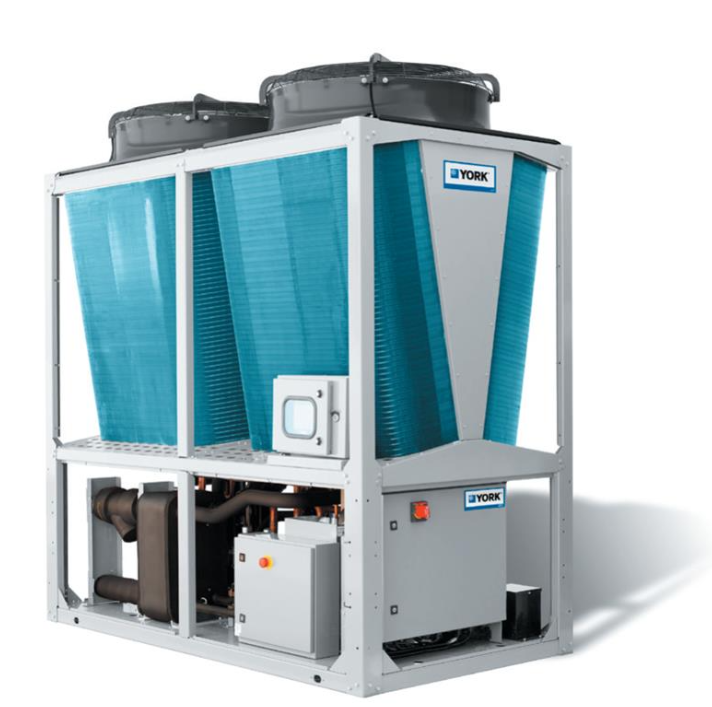
Air-cooled heat pump. Image supplied by York
This feature debunks common myths, unpacks real-world case studies and highlights how local innovation is reshaping the HVAC landscape.
York heat pumps – a powerful tool for energy savings and decarbonisation
With growing pressure to reduce carbon footprints and improve energy efficiency, heat pumps are emerging as an essential technology in the HVAC space. According to Gert Deale, sales manager at Airotech, heat pumps offer a broad and highly adaptable solution for building heating applications in South Africa and beyond.
Heat pumps are increasingly used in building heating, a trend that aligns with the shift away from traditional electric resistance heating and fossil-fuel-based boilers. “Heat pumps offer significant energy cost savings. They are widely adopted for their ability to reduce both operational expenses and carbon emissions,” says Deale.
York’s range of heat pumps – from 10kW to 650kW in air cooled, and up to 9 000kW in water cooled – are capable of heating water up to 65°C with standard refrigerants, and up to 95°C when using ammonia-based models under the Sabroe brand. This allows heat pumps to fully or partially replace boilers, particularly in commercial and hospitality applications like hotels and office buildings.
York offers both air-cooled and water-cooled heat pump models. The air-cooled options are simpler to install and reject heat to the ambient air, while water-cooled systems are more efficient, though more complex to integrate due to the need for a heat rejection loop – typically through a cooling tower or secondary circuit.
“These systems are highly efficient. The water operates within a closed-loop circuit, ensuring no loss and facilitating only thermal energy exchange. “York’s heat pumps can also operate as reversible systems, providing both heating and cooling from a single unit. This is especially advantageous in larger buildings, where year-round comfort is essential
Perhaps the biggest appeal of heat pumps is their efficiency. A standard air-source heat pump can deliver a Coefficient of Performance (COP) of 3:1, meaning for every 1kW of electricity consumed, 3kW of heating energy is delivered. This makes them particularly attractive in regions like South Africa, where electricity scarcity is a growing concern.
In addition to operational savings, heat pumps are vital for decarbonisation efforts. While not emission-free themselves, their high efficiency significantly reduces the indirect emissions tied to electricity generation. “In Europe, heat pumps are widely used as part of decarbonisation initiatives. South Africa can benefit just as much – if not more – by focusing on electricity savings,” says Deale.
With growing scrutiny on global warming potential (GWP) of refrigerants,York heat pumps are engineered to use low-GWP options, such as R1234ze, in addition to legacy refrigerants like R134a or R410A. While these environmentally safer gases are currently more expensive, their cost is expected to fall as adoption grows.
The York range uses refrigerants such as R134a and also the low-GWP refrigerants, and can improve the sustainability of commercial buildings and industrial processes (R454B, R1234ze, as well as R515B).
-

- Water-cooled heat pump Image supplied by York

-

- Complex heat pumps – water cooled.


Complex heat pumps – water cooled.
Do heat pumps generate heat?
Contrary to what the name might suggest, heat pumps do not generate heat – they move it. Using the refrigeration cycle, heat pumps transfer thermal energy from a cooler area (like outdoor air, even in winter) to a warmer space inside a building.
The process involves a refrigerant absorbing heat from the outside air, even in low temperatures. As the refrigerant changes from liquid to gas, it is compressed, raising its temperature and pressure. This hot gas then releases heat indoors as it condenses back into a liquid, ready to repeat the cycle.
What sets modern heat pumps apart is their ability to operate efficiently at much lower outdoor temperatures than earlier models, making them viable in a broader range of climates.
Are heat pumps efficient?
Heat pumps are among the most efficient heating systems available today. Their efficiency is commonly measured using the Coefficient of Performance (COP). A COP above 1 indicates that the system delivers more heat than the electrical energy it consumes.
Traditional electric furnaces typically operate at or below a 1:1 efficiency ratio, depending on how much energy is lost during combustion and ventilation. In contrast, an inverter-driven heat pump can reach a COP close to 4, meaning it can deliver up to four units of heat for every unit of electricity consumed.
This high efficiency is achieved by moving heat rather than generating it, dramatically reducing energy use – especially when compared to fossil fuel-based systems.

Installation commencing at Lydenberg High School. Supplied by Derick Gomez
Why the air from a heat pump doesn’t feel warm
It’s true that air supplied by a heat pump may not feel warm to the touch. Air at 35°C is enough to heat a room but feels cool relative to our body temperature (about 37°C).
To compensate, some systems are set to trigger an auxiliary (backup) heat source, such as electric resistance heating, to make the air ‘feel’ warmer. While this may improve subjective comfort, it reduces the overall system efficiency. It’s important to educate users that a lower outlet temperature does not mean the system isn’t working — it’s often a sign that it is working efficiently.
Does every room need its own ductless unit?
Ductless mini-split systems often use individual indoor units connected to a single outdoor compressor, allowing for zoned temperature control. While this setup can be ideal for retrofits or homes without ductwork, it’s not always the best solution.
A common issue is oversizing, where a unit is too powerful for the room it serves. Oversized systems can short-cycle, leading to poor humidity control, uneven temperatures, increased wear on components and reduced comfort.
Correct sizing according to a detailed load calculation is critical. This ensures the system matches the specific heating and cooling requirements of each space. In many cases, a mix of ducted and ductless units may be more effective, especially for larger areas or open-plan designs.
Do heat pumps leak refrigerant easily?
Refrigerant leakage is not inherent to heat pump technology — it’s typically the result of improper installation. Most leaks occur at flared connections where copper tubing is joined. If a flare is not formed or tightened correctly, or if torque specifications are ignored, leaks can occur.
Proper training, modern tools and attention to installation best practices can prevent these issues. When installed correctly, heat pump systems are reliable and maintain their refrigerant charge over many years of service.
-

- Roger Fawcett, founder of Mr Heat Pump. Image by © RACA Journal
-

- Michael Carter, wet engineer: AI Hot Water Company. Image by © RACA Journal
Perceptions that heat pumps are new, complicated and expensive
Inverter-driven heat pumps have been in use globally for decades and are a proven technology. Their perceived complexity often stems from unfamiliarity among some HVAC professionals, rather than the actual installation process.
Installing an inverter heat pump is comparable to installing a conventional air-conditioning unit. In many models, the outdoor unit supplies both power and communication to the indoor units, eliminating the need for separate indoor power supplies. Unlike gas furnaces, there’s no need for flues, combustion air intakes or gas lines – streamlining installation.
As for cost, inverter heat pumps may have a higher upfront price than basic systems with electric resistance backup.
However, they often require lower power capacity. For example, a traditional 36 000 BTU heat pump system with a 10kW electric heater may need 90 amps, whereas an equivalent inverter system without resistance heating might only need 30 amps.
-

- Heat pumps destined for Mr Heat Pumps.(1-7) Supplied by Mr Heat Pumps.


This can avoid the need for costly electrical upgrades and save significantly over time.
The long-term energy savings, reduced environmental impact, and potential for incentives make inverter heat pumps a cost-effective and future-ready solution.
Heat pumps are not a niche or emerging technology – they are a mature, efficient and highly adaptable solution for heating and cooling. Misconceptions often stem from unfamiliarity, improper sizing or incorrect installation – not from faults in the technology itself.
When properly selected, installed and maintained, heat pumps can outperform traditional HVAC systems in both comfort and efficiency — while significantly reducing carbon emissions and operational costs.
Simplicity is the height of sophistication
Heat pumps are rapidly emerging as the preferred solution for efficient hot water generation, especially for large-scale institutions where traditional electrical geysers contribute significantly to energy consumption. Leveraging air- conditioning technology in innovative ways, some South African manufacturers are now leading the charge in redefining how hot water is produced and maintained, without the high costs and energy demands of older systems.
For instance, Derick Gomez, director of MD Airconditioning, has developed a proprietary heat pump system built on the fundamental refrigeration cycle of air-conditioning units. His design replaces traditional geyser elements with a specially engineered heat exchanger, effectively turning a standard geyser into a high-efficiency heat pump water heater.
Gomez’s design hinges on the concept that “simplicity is the height of sophistication”. By stripping away the usual clutter– multiple control systems, switches and sensors – his system reduces the points of failure and lowers production costs. The heart of the system lies in using a conventional 9 000 or 12 000 BTU air-conditioning condenser unit paired with a custom-made heat exchanger. The geyser’s electrical element is removed entirely, and the exchanger is fitted in its place.
The result? A system that uses the refrigeration cycle’s ‘hot side’ to heat water, with a Coefficient of Performance (COP) of 5.6 – well above most standard heat pumps and air-conditioning units. This translates into serious energy savings. Traditional geyser elements draw 3–4kW, while Gomez’s heat pumps operate at only 700–800 watts, offering institutions dramatic reductions in monthly electricity use.
A case study from lydenburg
A real-world example of this technology is currently being implemented at a large school in Lydenburg, Mpumalanga.
The school is undergoing a phased rollout of 80 units, aimed at replacing energy-intensive geysers in its dormitories. The project began with a pilot phase of eight units, monitored by an independent electrical engineer to verify energy savings and performance (this case study will be published as a project article in a future RACA Journal).
This case illustrates the broader appeal of heat pumps for institutions seeking cost-effective, long-term energy solutions. According to Gomez, investment payback periods are often as short as 18 months, thanks to the significant energy savings and lower maintenance costs.
Unlike integrated or combo heat pump systems, MD’s approach relies on widely available air-conditioning components. Should a component fail, repairs are easier and cheaper, since standard condensers are far more accessible than proprietary heat pump parts.
Several key features make MD’s system particularly attractive to facilities managers and technical teams:
- Liquid refrigerant heating: A technique Gomez adopted years ago, now mirrored in newer air-conditioning systems.
- Extended pipe runs: Units can be installed up to 15m away from the geyser without upsizing, unlike many heat pumps that max out at 7.5m or 10m.
- ‘Inverter-like’ operation: The system gradually increases amperage as the water temperature rises – starting from as low as 2.9 amps – mimicking inverter efficiency without the cost or complexity.
While its primary function is water heating, the system can also be adapted for comfort cooling with minimal modification, highlighting its design flexibility.


Efficiency versus solar and gas
Heat pumps are often compared to solar water heaters and gas geysers. However, Gomez argues that heat pumps consistently outperform both, especially in climates with limited sunlight or rising gas costs. Solar systems may offer daytime efficiency but frequently revert to using their electric elements during high-demand morning and evening periods, offsetting the gains made during daylight hours. In contrast, heat pumps operate independently of sunlight and offer reliable savings regardless of the time of day.
Additionally, with potential LP gas price hikes and supply concerns in South Africa, many institutions are now favouring electric heat pumps as a more predictable and scalable solution.
MD Airconditioning’s system also stands out for its use of locally sourced materials. While outdoor condenser units are imported, the custom heat exchanger components – such as the copper coil and stainless steel flange – are proudly South African, sourced from manufacturers like Maksal and local suppliers of 316 stainless steel. Gomez notes that while local components may be more expensive than imported alternatives, the quality and longevity are superior.
Another important distinction lies in who installs and maintains these systems. While many heat pump systems are handled by plumbers, Gomez emphasises that heat pumps are fundamentally refrigeration systems, often beyond the expertise of general plumbing contractors. As heat pump installations grow in sophistication, he sees a natural convergence between the air- conditioning and plumbing industries – a trend likely to shape the future of HVAC and water heating solutions.
Whether in schools, hospitals, residential complexes or commercial facilities, heat pumps are proving to be a reliable, efficient and cost-effective solution for hot water needs. By leveraging air-conditioning principles and simplifying the system design, manufacturers like MD Airconditioning are making it easier and more affordable for institutions to make the switch.