By Eamonn Ryan
At Solar & Storage Live Africa in Gauteng, the session ‘Unlocking the grid: solving SA’s interconnection bottlenecks’ turned into a candid fireside chat. Moderated by Maria Michael, managing director of Michael and Co Sustainable Power, together with Percy Koji, president and CEO: Hosana Green Energy, Michael asked a simple question with a complex answer: What does the early planning and approvals journey look like for an IPP trying to connect to the grid?
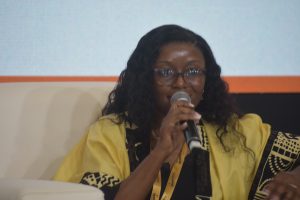
Maria Michael, managing director of Michael and Co Sustainable Power.
© RACA Journal
For Koji, now leading two 100MW solar projects in the North West Province, that journey began more than four years ago at a BRICS summit in Johannesburg. There, the North West Investment Agency called for investors willing to back projects in the province. Koji and his team raised their hands.
Step 1: The investment pledge and institutional entry
Koji describes how his company submitted an investment pledge through the North West Development Corporation (NWDC), demonstrating not only intent but also the “financial muscle” and access to capital partners required to make the project credible. This formal pledge opened the door for NWDC to communicate with the Greater Taung Local Municipality, signalling that a serious IPP wanted to invest in the region.
Step 2: Traditional authorities, land affairs and the community
Because the project would be built on land under traditional authority, the municipality then wrote to the local king. Percy describes engaging with:
- The kingdom (for political and customary legitimacy).
- The community (for social licence).
- The Department of Land Affairs (as legal custodian of the land).
They needed:
- Land authorisation from the king.
- Community consultation to ensure buy‑in and avoid future disputes.
- Formal sign‑off from Land Affairs to ensure no one could later argue they had not been consulted.
This stage alone took years and mirrored processes Maria had seen in other African markets like Kenya and Namibia.
Step 3: The council resolution – municipal political buy-in
With traditional and community backing in place, the project moved into formal municipal decision-making.
Koji explains the Council Resolution process:
- Requesting to present at a special council sitting.
- Presenting the project to councillors, the Speaker, and the Mayor.
- Securing a Council Resolution – a collective, minuted decision formally supporting the project.
“Every councilor and the speaker and the mayor had to agree to our proposal as a collective,” he notes. This step is essential to avoid later challenges under the Public Finance Management Act (PFMA).
Step 4: Public comment and legal risk management
The municipality then issued a public request for information or input. This allowed:
- Other market participants to support or object.
- The municipality to demonstrate transparency.
- The IPP to de‑risk later accusations of unfair, opaque procurement.
Percy is explicit: by being patient and following this process over about four years, he can now “sleep at night”. He’s confident the project is legitimate, defensible and not exposed to corruption allegations.
Step 5: Towards the Power Purchase Agreement (PPA)
In parallel, through NWDC, Koji worked towards a draft Power Purchase Agreement (PPA) with the municipality. NWDC acts as custodian of the PPA, ensuring that by the time construction is complete, there is a legally binding offtake in place.
With this groundwork done, the provincial government supports the IPP through grid‑connection steps, aiming to make the technical interconnection smoother since the political and legal groundwork has been laid.
As Solar & Storage Live Africa highlighted in this session, solving “interconnection bottlenecks” isn’t only about transformers and substations; it’s also about patiently navigating every institutional gatekeeper, from kings and communities to councillors and development corporations.