By Eamonn Ryan
Financial institutions are undergoing a structural shift as sustainability, ESG principles and climate finance move from peripheral considerations to core banking strategy. This is part one of a two-part series.
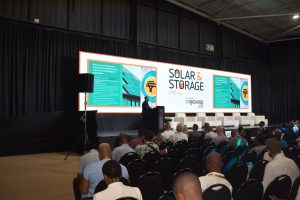
One of the most significant innovations highlighted is a restructuring of how solar finance is treated within traditional lending frameworks.© RACA Journal
In a discussion from FNB South Africa at the Solar & Storage Live Africa 2026 expo, two senior executives outlined how banks are repositioning themselves not just as lenders, but as enablers of the energy transition.
At the centre of this evolution is a simple but powerful idea: scaling low-carbon infrastructure is no longer only about technology or capital availability, but about partnerships, education and accessibility.
Across global markets, banks are increasingly stepping into climate finance ecosystems alongside development institutions such as the IFC and World Bank. The emphasis, as highlighted in the discussion, is on mobilising blended finance structures that can de-risk investment and accelerate adoption of renewable energy at scale. FNB stressed that no single institution can close the funding gap alone – scaling sustainability requires co-ordinated capital, technical expertise and long-term collaboration across ecosystems.
At the same time, the institution acknowledged a persistent challenge: affordability and access. While the cost of solar and related technologies has fallen significantly over the past decade, barriers remain in structuring finance in a way that is both inclusive and practical for end users. This is where the role of financial institutions becomes critical – not just as funders, but as designers of accessible energy solutions.
A major theme emerging from the discussion is the importance of education in driving adoption. Many individuals and businesses still struggle with understanding system sizing, performance expectations, and payback dynamics. Without this knowledge layer, even well-structured financial products can fail to achieve uptake. FNB highlighted that simplifying the customer journey is essential, ensuring that advisory support and turnkey solutions sit alongside financing.
This thinking has led to the development of a more integrated approach to energy finance, where sustainability is no longer treated as a separate product line, but embedded into broader banking services. The focus is shifting toward combining education, advisory tools and financing into a single ecosystem that also supports behavioural change – encouraging energy conservation and efficiency before new generation capacity is even installed.
For small business customers, this includes a staged approach: starting with education and energy awareness, followed by conservation behaviours, and then progressing to energy efficiency upgrades such as efficient appliances and heat pumps. Only once demand is better understood and reduced does solar system sizing become relevant, ensuring customers do not overinvest or face unnecessarily long payback periods.
One of the most significant innovations highlighted is a restructuring of how solar finance is treated within traditional lending frameworks. FNB has introduced mechanisms that allow solar investments to sit within existing loan-to-value structures, helping customers avoid being penalised when adding renewable energy systems to property finance. This removes a key friction point in adoption and ensures that energy upgrades remain financially viable at household level.
Ultimately, part one of the discussion reflects a broader shift in banking philosophy: from transactional lending to ecosystem enablement. Sustainability is no longer an adjacent consideration – it is becoming central to how financial institutions design products, manage risk and engage with customers.
© RACA Journal