By Eamonn Ryan
If Eskom’s emerging strategy succeeds in attracting more data centre investment to South Africa, the consequences will extend well beyond the country’s electricity market. This is part two of a two-part series.
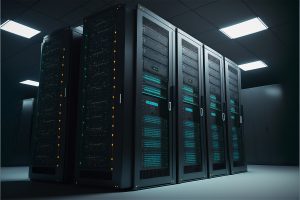
Water availability and local climatic conditions mean that cooling-system selection cannot simply follow overseas trends.
SVStudioart | Magnific.com
For the HVAC&R industry, the opportunity could be substantial. The rapid growth of artificial intelligence and cloud computing is driving a fundamental change in how data centres are designed. More computing power means greater electrical consumption, but it also means greater heat loads – and that heat has to be removed continuously.
This makes thermal management one of the most critical components of modern data centre design.
The cooling challenge
A useful rule of thumb in conventional data centre design is that virtually all of the electrical energy consumed by IT equipment ultimately has to be rejected as heat. Consequently, a facility with a 1MW IT load requires a cooling and heat-rejection strategy capable of dealing with an approximately equivalent thermal load.
As rack densities increase, however, the challenge becomes significantly more complex. Traditional air-based cooling remains appropriate for many applications, but high-density AI workloads can push individual racks far beyond the levels for which conventional room cooling was originally designed.
This is accelerating interest in technologies such as direct-to-chip liquid cooling, rear-door heat exchangers and immersion cooling.
For South Africa’s HVAC&R industry, this creates opportunities in an area that is moving rapidly from specialist technology towards mainstream data centre infrastructure.
Efficiency becomes as important as capacity
The other major consideration is efficiency. Data centre operators require high availability, but they also face pressure to control operating costs and improve their environmental performance. Cooling can represent a significant proportion of a facility’s energy consumption, making system efficiency an important component of overall data centre economics.
This creates opportunities for advanced chillers, free cooling where climate conditions permit, intelligent controls, variable-speed pumping and fans, heat rejection optimisation and increasingly sophisticated monitoring systems.
South Africa’s climate can also be advantageous in certain applications. The potential to use ambient conditions for partial or full free cooling, depending on location and system design, can reduce mechanical cooling requirements during suitable periods.
At the same time, water availability and local climatic conditions mean that cooling-system selection cannot simply follow overseas trends. Solutions need to be engineered for South African operating conditions.
A different conversation about data centres
The development also provides an important counterpoint to the argument that South Africa cannot accommodate major new data centres because of electricity constraints. The country still has genuine infrastructure challenges, and Eskom’s surplus should not be interpreted as a guarantee that every proposed facility can connect wherever and whenever it wants. Transmission capacity, connection timelines and local grid constraints remain critical.
Nevertheless, there is a significant difference between saying South Africa cannot support data centres and saying data centre developments must be carefully matched to available generation and grid capacity.
Eskom’s reported approach suggests that the utility increasingly sees large energy consumers as potential customers rather than simply additional pressure on a constrained system.
That could be particularly significant for the data centre industry. And every new megawatt of computing capacity brings with it another requirement: somewhere, somehow, that heat must be managed.
For HVAC&R contractors, consultants, manufacturers and technology suppliers, South Africa’s emerging data centre boom could therefore represent much more than another construction trend. It could become one of the industry’s most important new areas of growth.