By Eamonn Ryan
Pan-African Data Centre Conference 2026 – interview with Bafodé Dramé, sales manager Maghreb & Francophone Africa, Camfil.
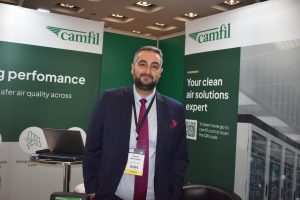
Bafodé Dramé, sales manager Maghreb & Francophone Africa, Camfil.
© RACA Journal
Africa’s fast‑growing data centre sector is waking up to a quieter, invisible threat: corrosive airborne gases that attack circuit boards, chips and other critical components.
At the Pan African Data Centre Conference 2026, Dramé explained how smarter air filtration and real‑time corrosion monitoring can protect uptime while cutting operating costs.
From dust to gases: what really threatens uptime
For years, operators have focused on particle filtration. Dramé notes that while almost any facility will have filters, the energy class makes a major difference:
- Upgrading from energy class C to A can deliver around 40% energy savings
- That equates to roughly EUR170 per filter per year, plus longer life and fewer change‑outs
But as facilities densify and AI workloads grow, corrosive gases – not visible dust – are increasingly damaging PCBs and electronics, risking unplanned downtime that can cost operators and clients heavily by the hour.
To address this, Camfil has introduced Air Image Core, a real‑time corrosion monitoring system designed for data halls and other high‑value areas.
The device:
- Monitors copper and silver corrosion levels – the key metals in PCBs
- Shows gas corrosion classes (G1 = safe; higher classes = rising risk)
- Needs around 24 hours to stabilise in a new environment
- Logs time‑stamped data and sends alerts to the BMS when conditions worsen
“When you move from G1 to G2 or G3, that’s the signal to act. It could be the wrong cleaning chemical, a humidity issue, or external gas ingress. The point is: you know, and you can respond,” says Dramé.
Using the data, Camfil specifies carbon media and gas phase filters matched to the actual contaminant mix, rather than guessing.
Site selection: highways, airports and refineries
Dramé points out that the “luxury” of building only in cool, clean climates is gone. Data centres in Africa now commonly sit near highways, airports or industrial plants, bringing exposure to:
- NOx, SO₂ and ozone
- Jet fuel VOCs and engine exhaust
- Other acidic gases that accelerate corrosion
Camfil’s response is a pre‑study that combines GPS, weather and air sampling to quantify local pollutants. If the site is clean, operators may not need gas filtration. If not, Camfil designs an appropriate carbon filtration stage, ideally into a pre‑planned slot in the AHU.
“Leave space in the air handling unit for gas filtration. Then, if measurements show you need it later, it’s a simple retrofit – not a full rebuild,” Dramé advises designers.
Energy, sustainability and insurance
Convincing operators to adopt higher‑efficiency filters and monitoring is not always easy, despite the business case. “It all sounds logical – energy savings, less maintenance, more uptime. But conservatism is global. People resist change,” says Dramé.
At the same time, insurance companies are tightening expectations as AI racks and chips become ever more expensive. Being able to show continuous G1‑class environmental reports can help reduce insurance premiums, while poor control raises risk.
“In the future, monitoring and clean air won’t just be best practice – they’ll be a condition for getting insured,” Dramé predicts. With local partners in Johannesburg and Cape Town, Camfil is positioning itself to support operators across South Africa, the Maghreb and Francophone Africa, as the region’s digital backbone scales from megawatt to gigawatt data centres.
“In this new landscape, clean, well‑managed air is as critical as power and cooling to keep Africa’s data centres online.”